* Question
What is harmonic current?
* Answer
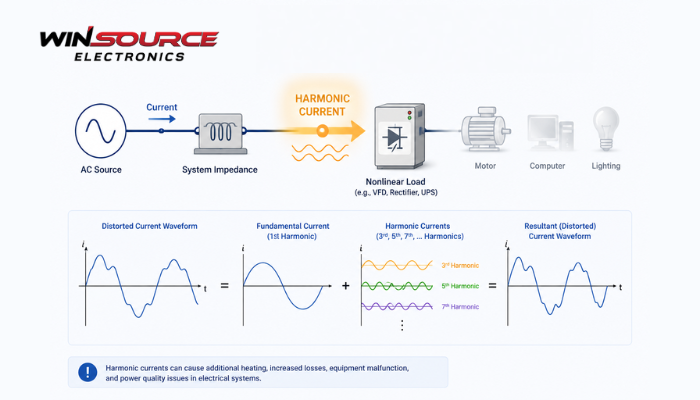
Harmonic current is an unwanted current component whose frequency is an integer multiple of the fundamental AC frequency. In a standard power system, the fundamental frequency is usually 50 Hz or 60 Hz. When the current waveform is distorted by non-linear loads, additional current components appear at higher frequencies, such as the 2nd, 3rd, 5th, or 7th harmonic.
In simple terms, harmonic current means the current is no longer flowing as a clean sine wave. Instead, it contains extra frequency components that can affect power quality, increase heat, and place additional stress on electrical equipment.
Harmonic current is commonly generated by devices that use power conversion circuits. Typical sources include switching power supplies, rectifiers, inverters, variable frequency drives, LED drivers, UPS systems, and other power electronic devices. These circuits do not draw current evenly from the AC supply, which causes waveform distortion.
For electronic components, harmonic current is important because it can directly affect reliability and service life. Capacitors may experience higher ripple current and overheating. Inductors and transformers may suffer from additional core loss and temperature rise. Power semiconductors, connectors, and PCB traces may also face extra thermal stress if the harmonic content is not properly controlled.
High harmonic current can lead to several system-level problems, including lower power efficiency, voltage distortion, electromagnetic interference, overheating, nuisance tripping of protection devices, and reduced equipment lifespan. In three-phase systems, certain harmonics, especially the 3rd harmonic and its multiples, can also increase neutral conductor current.
Engineers usually evaluate harmonic current through harmonic spectrum analysis or total harmonic distortion of current, also known as THD-I. A lower THD-I value usually indicates a cleaner current waveform and better power quality.
To reduce harmonic current, designers may use power factor correction circuits, EMI filters, harmonic filters, optimized power supply topologies, and properly rated passive components. Component selection is also important. Capacitors, inductors, transformers, and power devices must be chosen according to actual ripple current, frequency stress, temperature conditions, and long-term reliability requirements.
In summary, harmonic current is a key power quality factor in modern electronic systems. It is mainly caused by non-linear loads and power conversion circuits. Understanding harmonic current helps engineers improve efficiency, reduce thermal stress, protect components, and build more reliable electrical and electronic systems.