* Question
What Are the Characteristics of Metal-Foil and Wire Strain Gauges?
* Answer
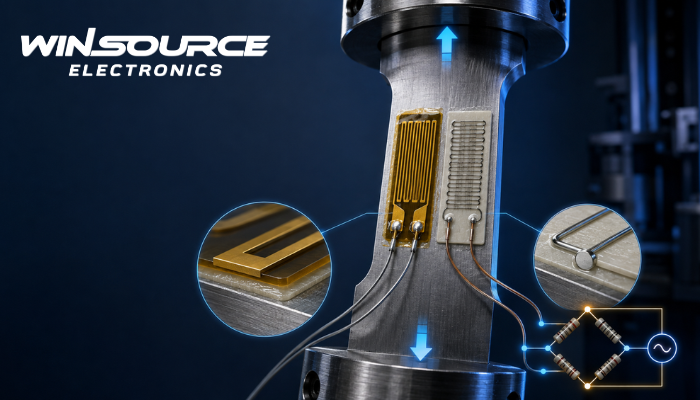
Metal-foil and wire strain gauges are resistive sensors that measure mechanical strain through a small change in electrical resistance. They use a conductor arranged in a grid and bonded to the surface of the test object. When the object stretches or contracts, the grid deforms with it and its resistance changes.
The term wire strain gauge is the correct English name for the Chinese term sometimes translated literally as “silk strain gauge.” It does not refer to a gauge made from silk.
Metal-Foil Strain Gauges
A metal-foil strain gauge uses a thin sheet of resistance alloy that is bonded to an insulating backing and patterned into a grid by photolithography and etching.
Its main characteristics include:
- Small size and short gauge lengths:Fine foil patterns can measure strain in confined areas or near stress concentrations.
- Flexible grid design:The sensing grid, end loops, solder tabs, and compensation patterns can be formed accurately in different shapes.
- Low transverse sensitivity:Wide end loops can be designed to reduce the response to strain perpendicular to the primary measuring axis.
- Good heat dissipation:The broad, flat conductor transfers heat efficiently to the backing and test surface, allowing higher excitation than a comparable fine-wire grid.
- Good fatigue performance:Properly selected foil gauges can withstand large numbers of strain cycles.
- Consistent mass production:Photolithographic manufacturing supports accurate and repeatable grid geometry.
- Temperature compensation options:Foil alloys and backing systems can be matched to materials with different thermal-expansion characteristics.
- Compatibility with strain rosettes:Multiple grids can be patterned at precise angles to measure biaxial or unknown strain directions.
Metal-foil gauges are the most common choice for load cells, torque sensors, pressure transducers, structural testing, and general experimental stress analysis. HBM describes foil strain gauges as patterned measuring grids laminated to an electrically insulating carrier material.
Wire Strain Gauges
A wire strain gauge uses a very fine resistance-alloy wire arranged in a zigzag grid and bonded to a paper, polymer, or other insulating backing. Some high-temperature or specialized designs use unbonded or ceramic-supported wires.
Its main characteristics include:
- Simple sensing principle and construction
- Good linearity within the intended strain range
- Availability in bonded and unbonded configurations
- Suitability for specialized high-temperature gauges when appropriate wire and support materials are used
- Ability to form the active elements of pressure, force, and displacement transducers
Compared with foil gauges, traditional wire gauges generally have several limitations:
- The fine wire dissipates heat less effectively.
- Forming small or complex grid patterns is more difficult.
- Rounded end loops can increase transverse sensitivity.
- The grid may require a longer installation area.
- Consistent high-volume production can be more labor-intensive.
- Fine wires and their joints may be vulnerable to handling or fatigue damage.
Key Differences
Characteristic | Metal-foil gauge | Wire gauge |
Sensing element | Etched metal foil | Fine resistance wire |
Pattern flexibility | High | More limited |
Minimum practical size | Generally smaller | Generally larger |
Heat dissipation | Better | More limited |
Transverse sensitivity | Easier to minimize | Often higher |
Mass-production consistency | High | More assembly-dependent |
Modern general-purpose use | Very common | Mainly specialized or legacy designs |
For either type, measurement performance also depends on the gauge alloy, gauge factor, resistance, gauge length, backing, adhesive, excitation voltage, temperature compensation, surface preparation, alignment, wiring, and environmental protection. A metal-foil gauge is usually preferred for general-purpose measurements, while a wire gauge may remain appropriate for certain transducer constructions or demanding temperature environments.