* Question
What Is a Piezoelectric Raindrop Sensor?
* Answer
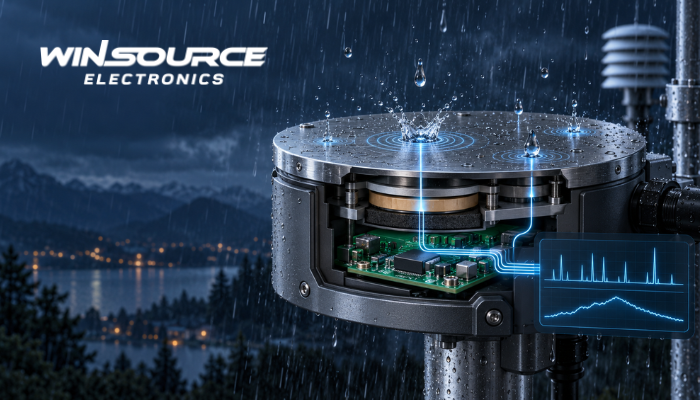
A piezoelectric raindrop sensor is a solid-state device that detects rainfall by sensing the mechanical impact of individual drops. It converts the vibration or deformation produced by each impact into an electrical signal through the piezoelectric effect.
Unlike a resistive rain board, it does not detect water by measuring conductivity between exposed traces. It responds to the force and vibration created when precipitation strikes its sensing surface.
How Does It Work?
A typical sensor contains:
- A rigid or slightly flexible impact surface
- A piezoelectric ceramic element or film
- A weather-resistant housing
- A charge amplifier or high-impedance signal-conditioning circuit
- Filtering and signal-processing electronics
When a raindrop strikes the surface, the impact creates a short mechanical pulse. This stress deforms the piezoelectric element, generating a corresponding electrical charge or voltage pulse.
The electronics amplify and filter the signal before analyzing characteristics such as:
- Pulse amplitude
- Pulse energy
- Impact duration
- Number and timing of impacts
Because larger or faster drops generally transfer more momentum to the surface, the signal can be calibrated to estimate drop size, rainfall intensity, accumulated precipitation, and rain-event duration. Commercial impact sensors may also distinguish rain from hail by analyzing differences in the impact signals.
Main Advantages
Piezoelectric raindrop sensors offer several practical benefits:
- No exposed conductive grid:Performance is not based on water bridging electrical traces.
- No moving collection mechanism:This reduces mechanical wear compared with tipping-bucket gauges.
- Fast response:Individual impacts can be detected almost immediately.
- Compact construction:The sensing element and processing electronics can fit into a small enclosure.
- Low maintenance:The impact surface can be easier to maintain than funnels and moving buckets.
- Multiple precipitation measurements:Suitable processing can provide rain onset, intensity, duration, accumulation, and drop-count information.
Limitations
The raw piezoelectric output does not directly equal rainfall depth. Accurate measurement requires calibration and signal processing because impact energy is affected by drop diameter, velocity, impact location, sensor construction, surface wetness, temperature, and wind.
Mechanical vibration, hail, insects, debris, vehicle movement, and handling can also create signals resembling raindrop impacts. Effective sensors therefore use mechanical isolation, thresholding, frequency filtering, and event-classification algorithms to reject false detections.
Common Applications
Piezoelectric raindrop sensors are used in:
- Compact weather stations
- Smart irrigation and agricultural monitoring
- Automotive rain-detection systems
- Building and window automation
- Environmental monitoring stations
- Solar-panel and outdoor-equipment control
- Portable and IoT weather instruments
When selecting one, engineers should verify the sensing area, minimum detectable drop, rainfall range, output interface, update rate, power consumption, operating temperature, enclosure rating, mounting requirements, heating options, calibration method, and resistance to vibration and environmental contamination.