* Question
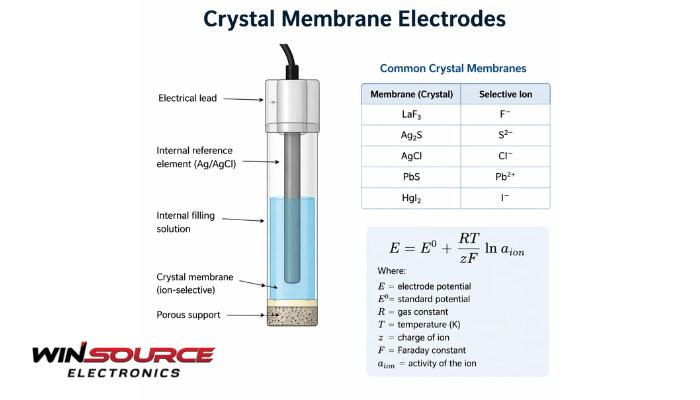
What are crystal membrane electrodes, and how can they be classified based on different sensitive membranes?
* Answer
Crystal membrane electrodes are a type of sensor used to measure specific ions in a solution. They consist of a sensitive membrane that interacts with the target ions, producing a measurable signal. These electrodes rely on the interaction between the membrane material and the ions to generate an electrical potential, which is proportional to the ion concentration.
These electrodes can be classified based on the type of sensitive membrane used. Common types include:
- Glass Membrane Electrodes
These electrodes are widely used for pH measurement. The glass membrane is sensitive to hydrogen ions (H+), allowing the electrode to measure the pH of a solution accurately. - Ion-selective Membrane Electrodes
These electrodes are designed for specific ions such as sodium, potassium, or calcium. The membrane is tailored to selectively interact with a particular ion, providing high specificity for that ion’s concentration. - Polymer Membrane Electrodes
Polymer-based membranes are often used in electrodes for detecting a range of ions. These membranes are flexible and can be tailored to provide high selectivity for various ions, such as chloride or nitrate. - Solid-State Electrodes
These electrodes utilize a solid-state membrane, typically made of a crystal or metal oxide. They are often used in specialized applications, such as detecting gases or certain metal ions.
The classification of crystal membrane electrodes based on the sensitive membrane helps ensure accurate and reliable measurements for a variety of applications, from environmental monitoring to medical diagnostics.