
* Question
What are the key design elements of a state machine in digital systems?
* Answer
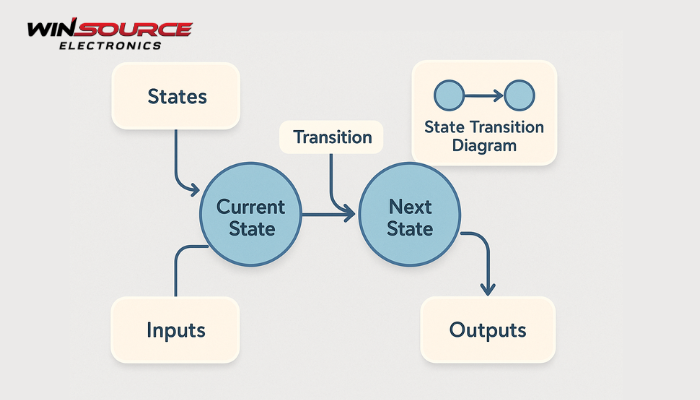
A state machine (or finite state machine, FSM) is a mathematical model used to design sequential logic systems.
It describes how a system transitions between different states based on input conditions and timing events.
State machines are fundamental in digital circuit design, embedded systems, control logic, and protocol implementation.
To design a reliable state machine, several key elements must be clearly defined and implemented.
1. States
A state represents a specific condition or mode of operation in which the system can remain until an input or event triggers a transition.
Each state corresponds to a distinct output configuration or internal activity.
Examples: Idle, Processing, Error, Completed.
Design consideration:
- Clearly identify all possible system states.
- Avoid redundant or undefined states to prevent unexpected behavior.
2. Inputs
Inputs are external or internal signals that influence state transitions.
They can include sensor readings, user commands, control flags, or clock signals.
Design consideration:
Define valid input combinations and their timing relationship.
Handle unexpected or invalid inputs through default or error states.
3. Outputs
Outputs define the system’s response in each state.
Depending on the FSM type, outputs can depend only on the current state (Moore machine) or on both the current state and inputs (Mealy machine).
Design consideration:
- Determine whether the design requires synchronous(clocked) or asynchronous output behavior.
- Ensure output transitions are glitch-free and timing-safe.
4. State Transitions
A transition defines the rule for moving from one state to another.
Transitions are triggered by specific input conditions or events and often represented in state diagrams or tables.
Design consideration:
- Every possible input condition should map to a valid next state.
- Use reset conditions or default paths to ensure predictable startup behavior.
5. Clock and Timing Control
In synchronous digital systems, state transitions are governed by a clock signal.
The clock defines when inputs are sampled and when the next state becomes active.
Design consideration:
- Ensure timing constraints (setup/hold times) are met.
- Consider clock domain synchronization if multiple clocks are used.
6. Reset and Initialization
A reset mechanism defines the initial or “safe” state after power-on or system fault.
Without a defined reset state, the system may start in an undefined condition.
Design consideration:
- Include both power-on resetand manual reset
- Guarantee that all outputs are stable after reset.
7. State Encoding
Each state must be represented by a unique binary code in hardware implementation.
Common encoding methods include binary, one-hot, and Gray code schemes.
Design consideration:
- Choose encoding based on hardware resources, speed, and simplicity.
- One-hot encoding simplifies decoding but uses more flip-flops.
Summary Insight
In summary, the core design elements of a state machine include:
states, inputs, outputs, transitions, clock/timing control, reset mechanisms, and state encoding.
Together, these elements define the logical and temporal behavior of a sequential system.
A well-designed FSM ensures predictable, reliable, and scalable control logic, making it indispensable in applications ranging from digital communication protocols and embedded controllers to FPGA/ASIC design.

COMMENTS