* Question
What Are the Main Features of LwIP?
* Answer
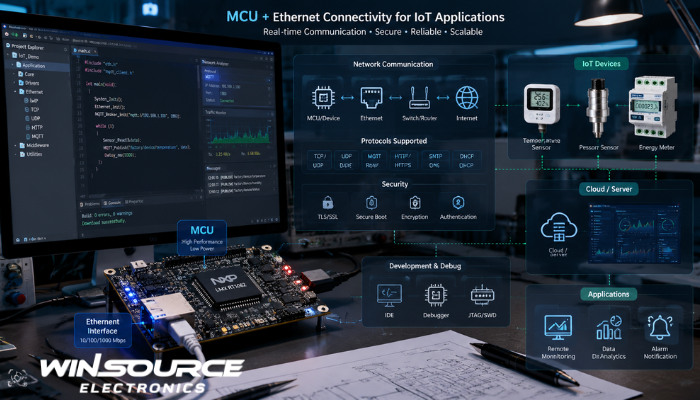
LwIP (Lightweight IP) is an open-source TCP/IP protocol stack designed for embedded systems with limited memory and processing resources. It was originally developed to provide full Internet connectivity for small microcontrollers while maintaining low hardware requirements.
LwIP is widely used in embedded networking applications, including industrial control systems, IoT devices, smart appliances, and automotive electronics.
What Are the Key Features of LwIP?
1. Lightweight Design
The most important feature of LwIP is its small size and low resource consumption.
Compared with traditional TCP/IP stacks, LwIP is optimized for embedded platforms with:
- Limited RAM and Flash memory
- Low-power processors
- Real-time operating requirements
This makes it suitable for microcontrollers such as ARM Cortex-M devices and other embedded processors.
2. Complete TCP/IP Protocol Support
Although designed for embedded environments, LwIP provides support for many essential Internet protocols, including:
- IPv4 and IPv6
- TCP (Transmission Control Protocol)
- UDP (User Datagram Protocol)
- ICMP (Internet Control Message Protocol)
- ARP (Address Resolution Protocol)
- DHCP (Dynamic Host Configuration Protocol)
- DNS (Domain Name System)
This allows embedded devices to communicate with standard network equipment and Internet services.
3. Flexible Operating Modes
LwIP supports different programming models according to system requirements.
The main modes include:
Raw API
The Raw API provides the highest performance with the lowest memory usage.
Advantages:
- No operating system required
- Fast response
- Suitable for resource-constrained systems
It is commonly used in small embedded applications.
Netconn API
The Netconn API provides a sequential programming interface.
Advantages:
- Easier application development
- Better abstraction compared with Raw API
- Suitable for systems running an RTOS
Socket API
The Socket API provides a standard BSD socket interface.
Advantages:
- Familiar programming model
- Easier software migration
- Suitable for developers with network programming experience
4. Low Memory Consumption
LwIP uses optimized memory management techniques to reduce system overhead.
Its design includes:
- Custom memory pools
- Packet buffer management (pbuf)
- Configurable protocol modules
Developers can enable or disable specific functions depending on application needs.
5. Support for Real-Time Embedded Systems
LwIP can work with many embedded operating systems and real-time operating systems (RTOS), including:
- FreeRTOS
- RT-Thread
- Zephyr
- Embedded Linux environments
This makes it suitable for applications requiring predictable communication performance.
6. Modular Architecture
LwIP uses a modular structure that allows developers to customize the network stack.
Developers can configure:
- Enabled protocols
- Memory allocation methods
- Network interfaces
- Performance parameters
This flexibility helps optimize the system for different hardware platforms and applications.
What Are the Common Applications of LwIP?
LwIP is widely used in embedded networking scenarios, such as:
IoT Devices
LwIP enables small devices to connect to networks and exchange data with cloud platforms.
Examples include:
- Smart sensors
- Connected devices
- Remote monitoring systems
Industrial Automation
Industrial controllers use LwIP for:
- Ethernet communication
- Equipment monitoring
- Data exchange between control systems
Embedded Systems
Applications include:
- Microcontroller-based products
- Network-enabled devices
- Embedded gateways
Automotive Electronics
LwIP can support communication functions in automotive embedded systems, including:
- Vehicle networking modules
- Diagnostic equipment
- Smart control units
Why Is LwIP Important for Embedded Networking?
As embedded devices become increasingly connected, developers need networking solutions that provide Internet communication without requiring powerful processors.
LwIP solves this challenge by offering:
- Compact implementation
- Broad protocol support
- Flexible integration
- Low hardware requirements
It allows engineers to add Ethernet and Internet connectivity to embedded products while maintaining system efficiency and reliability.