* Question
What are the common model naming conventions for humidity-sensitive resistors?
* Answer
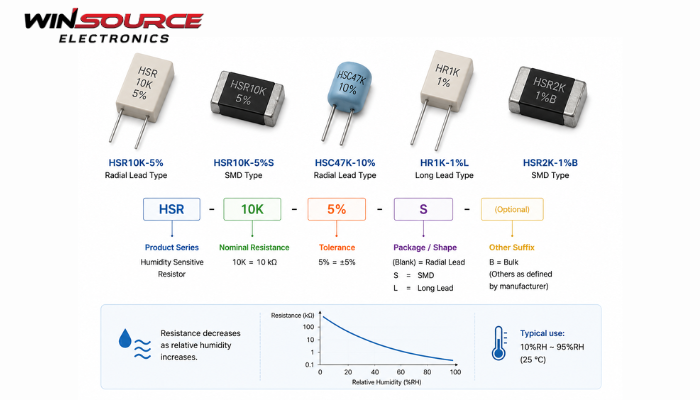
Humidity-sensitive resistors (often referred to as moisture-sensitive resistors or wetting-sensitive resistors) use specific model naming conventions to indicate their characteristics, tolerance, and environmental sensitivity. While naming methods can vary by manufacturer, the common elements include:
- Base Type Code:
- Indicates the resistor family or series, e.g., “HSR” for Humidity Sensitive Resistor.
- Resistance Value:
- Usually in ohms (Ω) or kilo-ohms (kΩ). Sometimes expressed with a letter code for decimal placement, similar to standard resistor notation (e.g., “103” for 10 kΩ).
- Tolerance:
- Denoted by letters or symbols, e.g., J = ±5%, K = ±10%, M = ±20%.
- Power Rating / Size:
- Indicates physical size or power dissipation capability, e.g., 1/4W, 1/8W, or a numeric code corresponding to size.
- Environmental Sensitivity / Coating Type:
- Codes for humidity sensitivity, protective coating, or packaging may be included, e.g., “H” for high humidity sensitivity, “E” for epoxy-coated.
- Special Features / Manufacturer Codes:
- Some manufacturers include extra letters or numbers for internal classification, production batch, or special characteristics.
Example:
- A model like HSR103J-1/4W-Hcould be interpreted as:
- HSR → Humidity-sensitive resistor series
- 103 → 10 kΩ
- J → ±5% tolerance
- 1/4W → 0.25 Watt rating
- H → high humidity sensitivity or protective coating
Note: Always refer to the manufacturer’s datasheet for exact model interpretation, as coding conventions can vary between brands like Vishay, Yageo, or Panasonic.