* Question
What basic operations does the 28X core perform when executing an instruction?
* Answer
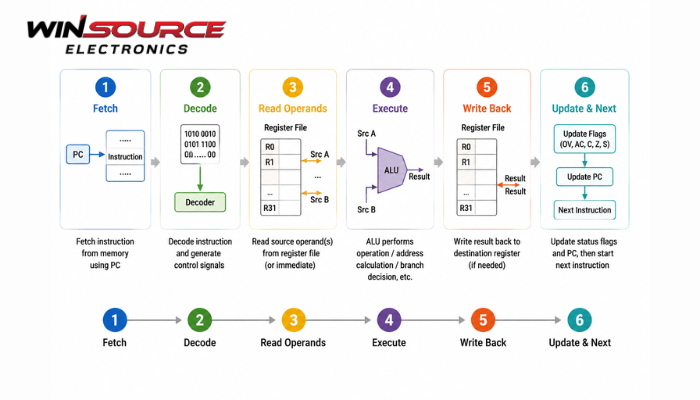
When the 28X core executes an instruction, it performs a sequence of fundamental operations that are common to most digital signal processor (DSP) or microcontroller cores. These operations can be grouped as follows:
- Instruction Fetch:
The core retrieves the next instruction from program memory, guided by the program counter (PC). This step ensures that the processor knows which operation to perform next. - Instruction Decode:
The fetched instruction is decoded to determine the operation type (arithmetic, logic, memory access, control) and the operands involved. Control signals are generated to direct the subsequent execution steps. - Operand Fetch:
Required data operands are read from registers or memory. For immediate instructions, the operand is embedded within the instruction itself. For memory instructions, data may be fetched from RAM or cache. - Execution / ALU Operation:
The arithmetic logic unit (ALU) or dedicated functional units perform the computation or logic operation specified by the instruction. For example, addition, subtraction, multiply-accumulate (MAC), bitwise operations, or data shifts. - Memory Access (if required):
If the instruction involves reading from or writing to memory (load/store), the core accesses the appropriate memory location and either retrieves data or stores the result. - Write-Back / Result Storage:
The result of the execution is written back to the destination register or memory location. This completes the instruction cycle. - Program Counter Update & Next Instruction Preparation:
The program counter is updated to point to the next instruction, considering jumps, branches, or interrupts. The core then repeats the cycle for the next instruction.
Summary:
The 28X core executes instructions through a standard sequence of fetch, decode, operand fetch, execution, memory access, write-back, and program counter update. Specialized cores like the 28X may include additional DSP-specific operations such as MAC units, circular buffering, and hardware looping to accelerate signal processing tasks.