* Question
What is the piezoresistive coefficient?
* Answer
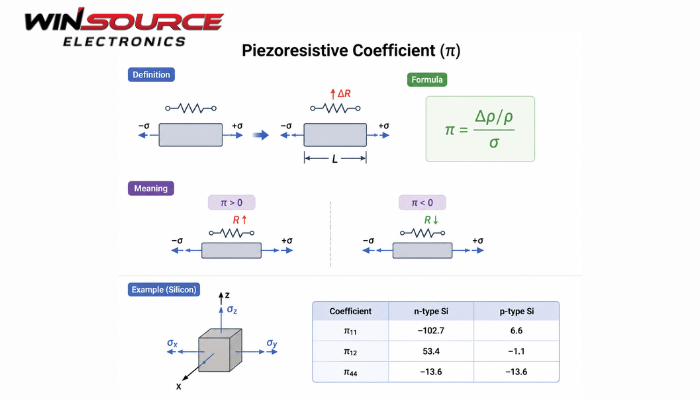
The piezoresistive coefficient is a parameter that quantifies how the electrical resistivity of a material changes in response to mechanical stress. It is a key property of piezoresistive materials, such as silicon and certain metals, and is fundamental in the design of sensors like strain gauges and pressure sensors.
Mathematically, the longitudinal piezoresistive coefficient πl and transverse piezoresistive coefficient πt are defined as:

Where:
- Δρ is the change in resistivity due to applied stress.
- ρ0 is the original resistivity of the material without stress.
- σ is the applied mechanical stress.
Key points:
- Direction-dependent:The coefficient may differ along different crystal orientations in semiconductors.
- Unit:Typically expressed in Pa−1 (inverse Pascal).
- Applications:Determines the sensitivity of strain gauges, MEMS pressure sensors, and other piezoresistive devices. A higher coefficient means a larger change in resistance for the same applied stress.
In essence, the piezoresistive coefficient connects mechanical deformation to electrical resistance changes, enabling the material to function as a stress or pressure sensor.