* Question
What Is a Pressure Sensor?
* Answer
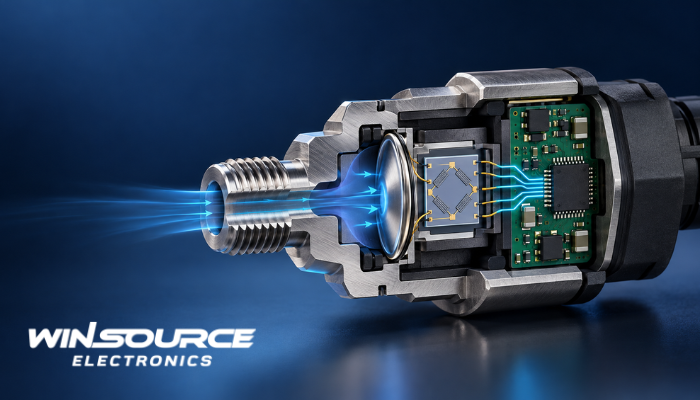
A pressure sensor is a device that detects the pressure of a gas or liquid and converts it into an electrical output signal. It is widely used in automotive systems, industrial equipment, medical devices, consumer electronics, and environmental monitoring.
How Does It Work?
Pressure applied to a sensing element causes a small mechanical deformation. The sensor converts this deformation into a measurable electrical signal using technologies such as:
- Piezoresistive sensing:Pressure changes the resistance of strain-sensitive elements.
- Capacitive sensing:Diaphragm movement changes the capacitance between two surfaces.
- Piezoelectric sensing:Applied force generates an electrical charge, making it suitable for dynamic pressure measurements.
- Optical sensing:Pressure changes a light path or optical property.
Signal-conditioning circuitry may amplify, compensate, and digitize the raw signal before providing an analog or digital output.
Main Types of Pressure Measurement
- Absolute pressure:Measured relative to a vacuum.
- Gauge pressure:Measured relative to atmospheric pressure.
- Differential pressure:Measures the difference between two pressure points.
- Sealed-gauge pressure:Measured relative to a sealed reference pressure.
Important Selection Parameters
Key specifications include:
- Measurement range
- Accuracy and resolution
- Sensitivity
- Maximum allowable pressure
- Response time
- Operating temperature
- Media compatibility
- Analog or digital output
- Supply voltage
- Package and pressure-port configuration
Selecting the correct pressure sensor requires matching its pressure reference, range, materials, interface, and environmental rating to the intended application.