* Question
What Are Shift Instructions?
* Answer
Shift instructions are processor operations that move the bits in a register or data word to the left or right by a specified number of positions. They are commonly used for fast multiplication or division by powers of two, bit-field extraction, data alignment, serial-data processing, and low-level arithmetic.
The exact instruction names and flag behavior depend on the processor architecture, but most instruction sets provide logical shifts, arithmetic shifts, and rotate operations.
Logical Shift Instructions
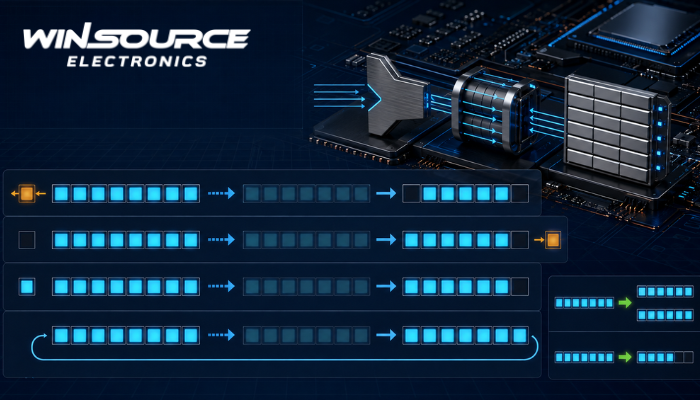
A logical left shift moves every bit toward the most significant end of the operand. Zeros are inserted into the vacated least significant positions, while bits shifted beyond the upper boundary are discarded.
For an unsigned value, shifting left by one position normally multiplies the value by two, provided that no significant bit is lost through overflow.
A logical right shift moves bits toward the least significant end and inserts zeros into the most significant positions. For an unsigned value, shifting right by one position performs integer division by two and discards any remainder.
Arithmetic Shift Instructions
An arithmetic right shift is designed for signed two’s-complement values. Instead of inserting zeros at the most significant end, it copies the original sign bit. This process, called sign extension, helps preserve whether the result is positive or negative.
Arithmetic and logical left shifts generally perform the same bit movement. Their interpretation differs according to whether the operand is treated as signed or unsigned.
Rotate Instructions
Rotate operations move bits in a circular pattern rather than discarding them:
- Rotate left:The most significant bit returns at the least significant position.
- Rotate right:The least significant bit returns at the most significant position.
- Rotate through carry:Bits rotate through the processor’s carry flag, effectively creating an additional bit position.
Rotates are widely used in cryptographic algorithms, checksums, bitstream processing, and multiword arithmetic.
Shift Count and Status Flags
The shift count may be fixed in the instruction, stored in a register, or supplied as an immediate value. Some processors support shifting an operand as part of another instruction, reducing the number of execution cycles.
A shifted-out bit may be stored in the carry flag. Depending on the architecture, shift instructions can also update zero, negative, sign, or overflow flags. Software should not assume flag behavior without consulting the relevant processor manual.
Common Applications
Shift instructions are used for:
- Multiplication and division by powers of two
- Extracting or positioning bit fields
- Creating masks and setting register fields
- Converting packed data formats
- Address and index calculations
- Signed-data scaling
- Serial communication and CRC processing
- Cryptographic and digital signal-processing algorithms
When using shifts, developers must consider operand width, signedness, overflow, discarded bits, and the result of shift counts equal to or greater than the word size. These edge cases vary between instruction sets and programming languages.