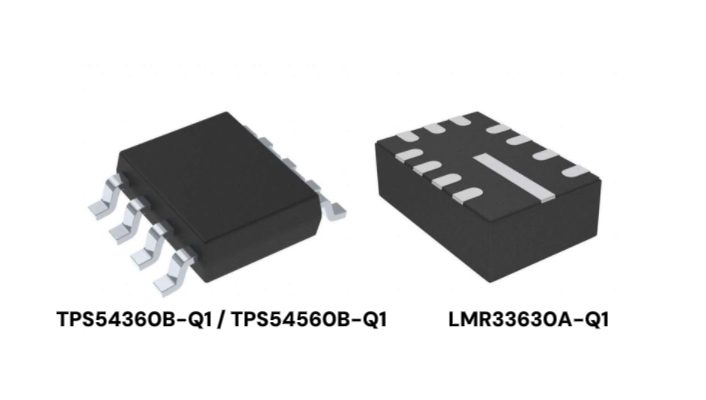
The TPS54360B-Q1, TPS54560B-Q1, and LMR33630A-Q1 are all automotive-qualified (AEC-Q100) step-down DC-DC converters from TI with an integrated high-side MOSFET, using peak-current-mode control to step 12 V, 24 V, and similar automotive and industrial rails down to a regulated output.
The three parts belong to two platforms: the TPS54360B-Q1 and TPS54560B-Q1 share a 60 V non-synchronous platform, while the LMR33630A-Q1 is a 36 V synchronous-rectification part. The first selection question is therefore the input-voltage platform and rectification method; current is the second step, decided once the platform is fixed.
Parameter Comparison
| Parameter | TPS54360B-Q1 | TPS54560B-Q1 | LMR33630A-Q1 |
| Input voltage range | 4.5–60 V | 4.5–60 V | 3.8–36 V |
| Rated output current | 3.5 A | 5 A | 3 A |
| Rectification | Non-sync, external Schottky | Non-sync, external Schottky | Synchronous, integrated HS/LS MOSFETs |
| Switching frequency | 100 kHz–2.5 MHz, adjustable | 100 kHz–2.5 MHz, adjustable | 400 kHz fixed (A version) |
| No-load quiescent IQ | 146 µA | 146 µA | 24 µA |
| Output voltage range | 0.8–58.8 V | 0.8–58.8 V | 1–24 V |
| Load-dump capability | 65 V (ISO 7637) | 65 V (ISO 7637) | VIN abs. max 38 V |
| Package | 8-HSOP PowerPAD | 8-HSOP PowerPAD | 12-VQFN HotRod 3×2 mm |
| Automotive qual. | AEC-Q100 | AEC-Q100 | AEC-Q100, functional-safety-capable |
Application Scenarios
- TPS54360B-Q1
60 V input, 3.5 A, non-synchronous rectification, surviving load-dump pulses up to 65 V per ISO 7637. The switching frequency is set by an external resistor across 100 kHz–2.5 MHz, allowing a trade-off between efficiency and external component size.
The non-synchronous architecture requires an external freewheeling Schottky diode. At full load and high input-output differential, this diode carries the bulk of the low-side conduction loss and is the main constraint on heat and efficiency in a non-synchronous design, so leave a thermal path for it during layout. Its strengths are wide input headroom and a mature reference-design ecosystem, suiting body control, sensor supplies, and industrial 24 V/48 V rail step-down that must ride out automotive bus transients with loads within 3.5 A.
- TPS54560B-Q1
It shares the platform, package, and pinout of the TPS54360B-Q1, the main difference being rated current raised from 3.5 A to 5 A. When the load sits near 3.5 A and needs margin, or when one PCB layout should accommodate two current grades, you can upgrade directly from the TPS54360B-Q1 with no redesign. Under the same thermal conditions, the 5 A part has more junction-temperature margin at a 3.5 A load, helping extend the life of the device and external capacitors. Its target applications match the TPS54360B-Q1, mainly 60 V rail step-down designs with loads of 3.5–5 A that need current margin.
- LMR33630A-Q1
36 V input, 3 A, synchronous rectification with integrated high- and low-side MOSFETs, requiring no external Schottky diode. Synchronous rectification replaces the freewheeling diode with an internal low-side MOSFET, removing that diode’s conduction loss and board area—the main reason peak efficiency reaches above 95% and the design suits miniaturization. It uses a 3×2 mm HotRod package.
Its no-load quiescent current is about 24 µA, roughly one-sixth of the TPS54x60B family (146 µA). For always-on ECUs that stay connected to the battery in standby or light load, this difference flows directly into the vehicle’s quiescent (dark) current budget, making the LMR33630A-Q1 better suited to standby-sensitive modules such as infotainment and telematics; it also offers Functional-Safety-Capable documentation.
- Two points to note. First, its VIN absolute maximum is 38 V, so it cannot directly absorb a 60 V-class load dump; on a 12 V automotive rail, the front end needs a TVS or clamp to hold the transient within 38 V. Second, its undervoltage lockout acts on the internal LDO output rather than monitoring VIN directly—unlike the VIN-sensed UVLO of the TPS54x60B—so a driver ported from a TPS54x60B needs its power-up logic adjusted accordingly.
Design Considerations
- Non-synchronous efficiency is tied to the chosen Schottky diode
The datasheet efficiency curves for the TPS54360B-Q1 and TPS54560B-Q1 are measured with a specific external Schottky diode. Actual efficiency is significantly affected by the selected diode’s forward voltage VF and reverse leakage: a higher VF raises full-load conduction loss, while increased reverse leakage at high temperature adds further loss. Actual efficiency for these two parts should therefore not be read straight off the datasheet curves; recompute it for the actual diode chosen, especially at high input-output differential and high duty cycle.
- The quiescent-current (IQ) figure is not system standby power
The 146 µA / 24 µA values are the device’s own non-switching consumption and exclude the feedback divider, enable circuit, and other external leakage. In an always-on ECU, the feedback divider current can be on the same order as the device IQ, depending on the divider resistor values. When estimating the vehicle dark-current budget, include the external circuitry rather than the device IQ alone.
- Load-dump capability must be assessed together with front-end protection
The TPS54x60B rating of 65 V (ISO 7637) is the device’s own capability; the system’s actual transient immunity also depends on input-capacitor voltage rating, PCB routing, and front-end protection devices. The LMR33630A-Q1 has a VIN absolute maximum of 38 V, so on a 12 V automotive rail it generally needs a front-end TVS or clamp, with the protection device rated by transient energy rather than peak voltage alone.
- Switching frequency is a three-way trade-off of efficiency, size, and EMI
The TPS54x60B’s 100 kHz–2.5 MHz adjustable range offers flexibility, but higher is not always better: a higher frequency shrinks the inductor and output capacitor but generally increases switching loss, requiring a trade-off between efficiency and size, and it shifts the EMI spectrum. The fixed-frequency LMR33630A-Q1 (A version, 400 kHz) removes the frequency-setting resistor but is not adjustable; if the system has a specific EMI-sensitive band to avoid, confirm during selection whether its fixed frequency and harmonics fall within that window.
- Thermal design should rely on the actual PCB, not datasheet thermal resistance
The datasheet thermal resistance (θJA) for all three is measured on a standard JEDEC board and can differ considerably from a real multilayer board’s copper area, via count, and component layout, so it should not be used directly for junction-temperature estimates. Heat dissipation in both the HotRod and PowerPAD packages depends on the vias and copper under the bottom thermal pad; leave an adequate thermal path during layout and verify with full-load temperature rise on actual hardware.
Product Summary
| Part Number | Mfr. | Key Features | Buy |
| TPS54360B-Q1 | TI | 60 V in, 3.5 A, non-sync, load-dump rugged, mature ecosystem | Buy Now |
| TPS54560B-Q1 | TI | 60 V in, 5 A, non-sync, pin-compatible with 54360B | Buy Now |
| LMR33630A-Q1 | TI | 36 V in, 3 A, synchronous, ultra-low IQ, functional-safety-capable | Buy Now |
WIN SOURCE supplies TI automotive-grade step-down DC-DC converters and related power-management devices for automotive electronics, industrial control, infotainment, and embedded power designs. Visit WIN SOURCE to check real-time stock and availability for the TPS54360B-Q1, TPS54560B-Q1, and LMR33630A-Q1.
©2026 Win Source Electronics. All rights reserved. This content is protected by copyright and may not be reproduced, distributed, transmitted, cached or otherwise used, except with the prior written permission of Win Source Electronics.