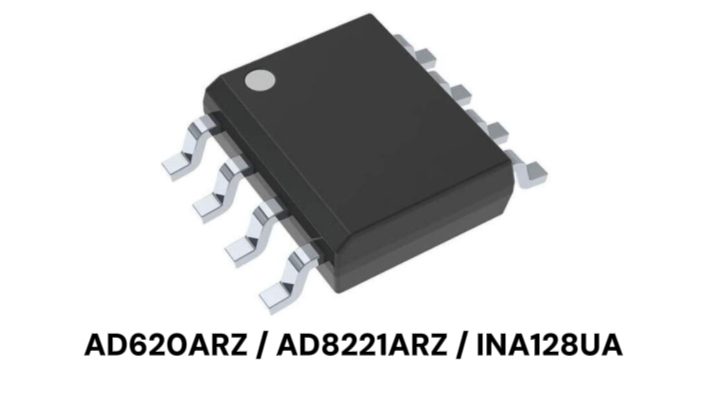
AD620ARZ, AD8221ARZ, and INA128UA are all precision instrumentation amplifiers whose gain is set by a single external resistor, widely used for front-end amplification of low-level differential signals in bridges, strain gauges, pressure sensors, thermocouples, ECG, biopotential acquisition, and industrial data acquisition.
Their selection priorities differ. The AD620ARZ leans toward maturity, low power, and a wide gain range; the AD8221ARZ is strong in common-mode rejection across frequency; and the INA128UA has the edge in input protection and industrial field robustness. Selection should therefore weigh gain requirements, interference spectrum, input-protection risk, source impedance, and cost together, rather than comparing any single parameter in isolation.
Parameter Comparison
| Parameter | AD620ARZ | AD8221ARZ | INA128UA |
| Gain range | 1–10,000 | 1–1,000 | 1–10,000 |
| Gain equation | G = 1 + 49.4 kΩ / RG | G = 1 + 49.4 kΩ / RG | G = 1 + 50 kΩ / RG |
| Input offset voltage | 125 µV max (A grade) | 60 µV max (AR grade) | 50 µV max |
| Input bias current | 1.0 nA max (25°C, wider over full temp) | 1.5 nA max (AR grade) | 5 nA max |
| CMRR (key values) | 73 dB min (G=1); 100 dB min (G=10) | 80 dB min (G=1), maintained to 10 kHz | 80 dB min (G=1); 120 dB min (G≥100) |
| Voltage noise (1 kHz) | 9 nV/√Hz typ | 8 nV/√Hz typ | 8 nV/√Hz typ |
| Bandwidth | 1 MHz (G=1); 120 kHz (G=100) | 825 kHz (G=1); 562 kHz (G=10) | 1.3 MHz (G=1); 200 kHz (G=100) |
| Input protection | No specified ±40 V input overvoltage protection; field inputs need external clamp/current limit | Has input-protection design, but not equivalent to a ±40 V rating | Specified ±40 V input protection |
Application Scenarios
- AD620ARZ
The AD620ARZ has a long application history, abundant reference material, and low power, suiting general-purpose precision signal conditioning where both cost and power matter. It fits systems with lower signal frequencies, higher front-end gain, and a relatively controlled input environment; once strong common-mode interference must be rejected at low gain, or the input may face miswiring, surges, or long-cable interference, additional protection and noise-immunity design must be evaluated.
- Typical applications:
Cost- and power-sensitive general signal conditioning
ECG, portable medical devices, low-speed data acquisition
Bridge measurement such as strain gauges, pressure, and weighing
Applications with higher gain and a lower common-mode interference band
- AD8221ARZ
The AD8221ARZ’s core strength is not gain range but its ability to maintain common-mode rejection at higher frequencies. This matters in practice because interference rarely comes only from DC or low frequencies—it also arrives from mains and its harmonics, switching supplies, long-cable coupling, and the external electromagnetic environment.
Compared with the AD620ARZ, the AD8221ARZ is stronger on zero-point stability, temperature drift, and common-mode rejection; the trade-off is a gain ceiling of 1,000. Where a very high single-stage gain is needed, it may have to be paired with a later gain stage or an ADC PGA.
- Typical applications:
Precision measurement with significant mains and harmonic interference
Long-cable industrial sensor inputs
Biopotential acquisition, medical front ends, high-precision data acquisition
Bridge measurement and industrial process monitoring
Upgrading noise immunity from an AD620-class design
- INA128UA
The INA128UA’s strength is its stronger input protection while retaining a wide gain range and good dynamic response. It suits systems whose inputs connect to long cables, external sensors, field terminals, or test interfaces—where the risk of miswiring, overvoltage, transients, and complex grounding often outweighs the pursuit of lower offset alone.
Two points to note.
- First, the INA128UA reaches 80 dB min CMRR at G=1 and can be referenced at 120 dB min at high gain, but its core strength is not CMRR over frequency; compared with the AD8221ARZ, the CMRR roll-off as frequency rises still needs attention in design.
- Second, the INA128UA gain equation uses 50 kΩ, unlike the 49.4 kΩ of the two ADI parts—so when switching from an ADI device, the original RG value cannot be reused directly; doing so introduces roughly a 1.2% gain error. High-source-impedance signal sources should also account for the added error from input bias current.
- Typical applications:
Industrial field, test-and-measurement equipment, and external input interfaces
Systems whose inputs may face miswiring, overvoltage, or transient interference
Front ends needing a wide 1–10,000 gain range
Applications needing good bandwidth at high gain
Designs wanting a TI part as a cross-brand alternative
Design Considerations
- Evaluate CMRR together with frequency and gain
CMRR depends jointly on gain, frequency, and source impedance, and the headline figure in a datasheet usually corresponds only to a specific test condition, not real-world interference performance.
For example, the INA128UA reaches 80 dB min CMRR at G=1 and is also strong at high gain; but the AD8221ARZ’s differentiating advantage is holding 80 dB min at 10 kHz at G=1. So when a system faces 50/60 Hz mains, harmonics, long-cable coupling, or switching noise, focus on the CMRR-versus-frequency curve rather than comparing single low-frequency or DC points.
- The RG resistor is itself a gain-error source
All three set gain with an external RG, so the RG tolerance, temperature drift, and layout feed directly into gain error. At high gain RG is small, and PCB trace, solder-joint, and contact resistance add up to a non-trivial error. High-precision designs should use a low-drift precision resistor placed close to the device.
- Input bias current needs a DC return path
An instrumentation amplifier’s inputs cannot float entirely. When the signal comes from a floating sensor, capacitive coupling, or transformer coupling, provide a DC return path for the bias current, or the input stage will saturate. The INA128UA’s bias current is relatively higher, so high-source-impedance applications should pay particular attention to the resulting added offset.
- Design input protection to the system risk
The INA128UA’s input protection is a key strength, but it does not mean external protection can be omitted—field surges, ESD, miswiring, cable-induced transients, and grounding differences can all exceed the chip’s own capability.
The AD620ARZ does not specify the kind of ±40 V input overvoltage protection the INA128UA has; when its input connects to external sensors or field cables, add current limiting, clamping, filtering, TVS, or reverse-protection per the system risk. The AD8221ARZ has an input-protection design but should still not be used at the INA128UA’s ±40 V level.
- Drive the REF pin from a low-impedance source
The REF pin sets the output reference point, and in single-supply systems is often used to bias the output to the ADC’s mid-scale. It should not be driven directly by a high-impedance divider network, which would degrade output accuracy and common-mode rejection. When the REF pin needs a bias voltage, use an op-amp buffer or a low-impedance reference source.
Selection Recommendations
For priority on maturity, low power, cost, and a wide gain range, choose the AD620ARZ. It suits low-speed precision conditioning, sensor interfaces, portable devices, and cost-sensitive designs.
When the main challenge is mains interference, long-cable common-mode noise, or a complex electromagnetic environment, prefer the AD8221ARZ. It suits bridge measurement, industrial sensing, biopotential acquisition, and high-precision data acquisition, and is the performance upgrade path from an AD620-class design.
When inputs carry a risk of miswiring, overvoltage, or field transients while still needing a wide gain range and good high-gain bandwidth, choose the INA128UA. It is especially suited to industrial test, measurement equipment, and external input interfaces.
Product Summary
| Part Number | Manufacturer | Core Positioning | Buy |
| AD620ARZ | Analog Devices | Classic low-power, mature and general-purpose, wide gain range | Buy Now |
| AD8221ARZ | Analog Devices | High CMRR over frequency, stronger noise immunity | Buy Now |
| INA128UA | Texas Instruments | Strong input protection, wide gain, good high-gain bandwidth | Buy Now |
WIN SOURCE supplies precision instrumentation amplifiers and related signal-chain devices from ADI and TI for industrial measurement, medical electronics, sensor interfaces, and data acquisition. Visit WIN SOURCE to check real-time stock and availability for the AD620ARZ, AD8221ARZ, and INA128UA.
©2026 Win Source Electronics. All rights reserved. This content is protected by copyright and may not be reproduced, distributed, transmitted, cached or otherwise used, except with the prior written permission of Win Source Electronics.