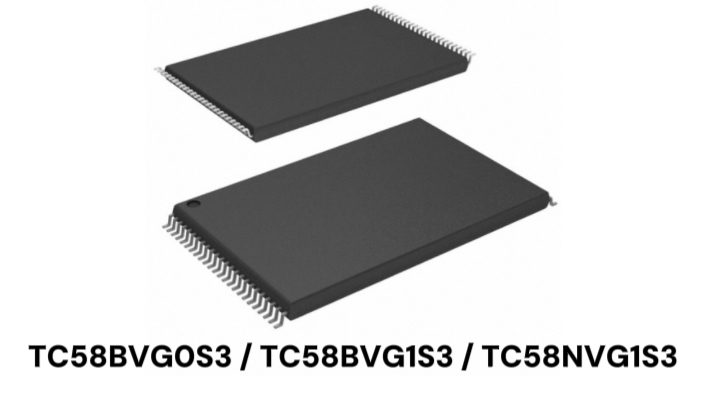
The TC58BVG1S3HTAI0, TC58BVG0S3HTAI0, and TC58NVG1S3HTAI0 are all SLC NAND Flash devices from Kioxia (formerly Toshiba Memory) with an x8 NAND I/O. They share closely matched packaging, supply voltage, and operating-temperature grades.
The three parts differ in just two respects: density and ECC architecture. Choosing between them therefore comes down to two questions—how much capacity the system needs, and whether ECC is handled on-chip inside the NAND or on the host controller side.
One point deserves particular attention: all three devices have entered the EOL / LTB phase of Kioxia’s TSOP-packaged product line. Whether you are maintaining a legacy project, stocking for ongoing production, or evaluating alternatives, plan ahead with the last-time-buy dates and current inventory levels in mind.
Parameter Comparison
| Parameter | TC58BVG1S3HTAI0 | TC58BVG0S3HTAI0 | TC58NVG1S3HTAI0 |
| Density | 2 Gbit | 1 Gbit | 2 Gbit |
| Error-Correction Architecture | BENAND™, on-chip ECC | BENAND™, on-chip ECC | Raw NAND, host-side ECC required |
| ECC Scheme / Requirement | Corrects 8-bit read errors per 528B + ECC Status Read | Corrects 8-bit read errors per 528B + ECC Status Read | No on-chip ECC; requires 8-bit / 512B ECC on the host side |
| Page Size / Spare | 2112B (64B spare) | 2112B (64B spare) | 2176B (128B spare) |
| Valid Blocks | 2008 min / 2048 max | 1004 min / 1024 max | 2008 min / 2048 max |
| Status | EOL / LTB | EOL / LTB | EOL / LTB |
All three devices share the following: 3.3V supply (2.7–3.6V), x8 NAND I/O, 48-TSOP I package, ‒40 to +85°C industrial operating temperature, and a 25ns min. read cycle time.
Application Scenarios
- TC58BVG1S3HTAI0
The TC58BVG1S3HTAI0 is a good fit for projects that need 2Gbit of capacity while keeping host-side ECC development simple. As a BENAND™ device, it integrates ECC on-chip, correcting 8-bit read errors for every 528B of data and supporting ECC Status Read.
Where the host NAND controller has no ECC engine, or where the goal is to reduce host-side ECC implementation work, the TC58BVG1S3HTAI0 saves development effort. It suits mid-to-high-capacity non-volatile storage applications such as industrial data logging, voice recording, image capture, and embedded file storage.
Keep in mind that on-chip ECC does not relieve the system of NAND management. Bad-block management, wear leveling, status reads, and exception handling still have to be implemented correctly at the system level.
- TC58BVG0S3HTAI0
The TC58BVG0S3HTAI0 shares the BENAND™ architecture of the TC58BVG1S3HTAI0, with essentially identical voltage, interface, package, spare area, and on-chip ECC scheme. The main difference is density, which drops from 2Gbit to 1Gbit, with a correspondingly lower valid-block count.
For projects whose actual data volume does not call for 2Gbit, or that need to balance capacity and cost within an existing BENAND-based design, the TC58BVG0S3HTAI0 is the better choice. When switching parts, still verify that the capacity parameters, address range, block count, and bad-block-table configuration match the original system.
- TC58NVG1S3HTAI0
The TC58NVG1S3HTAI0 is a better fit for 2Gbit designs that already have mature NAND control, ECC, and bad-block management implemented on the host side. Unlike the BVG family, it is a raw NAND device with no BENAND on-chip ECC, so the host side must supply at least 8-bit / 512B ECC.
Its 128B spare area—larger than the BVG family’s 64B—gives more room for custom ECC parity, metadata, bad-block markers, or FTL management information. For platforms that already have raw-NAND drivers, ECC algorithms, and production-validation experience, the TC58NVG1S3HTAI0 offers greater configuration flexibility at the system level.
How to Choose: ECC First, Then Capacity
Choosing among these three NAND parts is straightforward and can be done in two steps.
First, decide where ECC will be handled. If the host has no NAND ECC engine, or if you want to keep the driver and software stack simpler, lean toward BENAND™—the TC58BVG1S3HTAI0 or TC58BVG0S3HTAI0—whose on-chip ECC reduces the host-side ECC development burden. If the host already has a mature ECC, FTL, bad-block management, and wear-leveling solution, raw NAND—the TC58NVG1S3HTAI0—gives you more design flexibility.
Second, confirm that capacity meets system requirements. For 2Gbit, choose between the TC58BVG1S3HTAI0 and TC58NVG1S3HTAI0 according to ECC architecture; for 1Gbit, the TC58BVG0S3HTAI0 is the better fit. Capacity planning should look beyond the nominal figure to account for actual data volume, bad-block reserves, wear-leveling overhead, and end-of-life margin.
Are They Interchangeable?
The TC58BVG1S3HTAI0 and TC58NVG1S3HTAI0 are both 2Gbit, 3.3V, 48-TSOP I devices and look similar on some basic parameters, but they cannot be treated as drop-in replacements. The crucial differences lie in their ECC architecture and page/spare structure (see the parameter table). Moving from the TC58BVG1S3HTAI0 to the TC58NVG1S3HTAI0 requires the host side to have and enable compliant ECC capability; moving the other way requires confirming that the existing driver supports BENAND™ status reads and error handling. For these reasons, the BVG and NVG parts should not be swapped as ordinary pin-to-pin alternatives.
By contrast, the TC58BVG1S3HTAI0 and TC58BVG0S3HTAI0 both use BENAND™ and share a similar architecture, so switching between them is comparatively easier. Their density and block count differ, however, so the capacity parameters, address range, bad-block table, and file-system configuration in software still need to be adjusted accordingly.
Product Summary
| Part Number | Manufacturer | Key Features | Availability |
| TC58BVG1S3HTAI0 | Kioxia | 2Gbit, BENAND on-chip ECC | Buy Now |
| TC58BVG0S3HTAI0 | Kioxia | 1Gbit, BENAND on-chip ECC | Buy Now |
| TC58NVG1S3HTAI0 | Kioxia | 2Gbit, raw NAND, host ECC required | Buy Now |
Lifecycle and Procurement Recommendations
The TC58BVG1S3HTAI0, TC58BVG0S3HTAI0, and TC58NVG1S3HTAI0 have all entered the EOL / LTB phase of Kioxia’s TSOP-packaged product line. Per Kioxia’s TSOP EOL notice (Ref. HQ-SBD0315KAI), the last-time-buy order deadline is September 15, 2026, and the last-time-ship date is March 15, 2027.
For projects still in production, under repair, or being extended in service, we recommend confirming annual usage, failure rates, repair-spares requirements, and the alternative-part qualification cycle early, and completing your stocking plan before the LTB window closes.
WIN SOURCE can support stock inquiries and alternative-part sourcing for Kioxia SLC NAND, parallel NAND, serial Flash, and configuration memory—covering embedded storage, industrial control, data logging, and the maintenance of discontinued platforms. As all three devices have reached the EOL / LTB stage, WIN SOURCE encourage customers to confirm real-time stock, lead times, and replacement options for the TC58BVG1S3HTAI0, TC58BVG0S3HTAI0, and TC58NVG1S3HTAI0 as early as possible.
©2026 Win Source Electronics. All rights reserved. This content is protected by copyright and may not be reproduced, distributed, transmitted, cached or otherwise used, except with the prior written permission of Win Source Electronics.