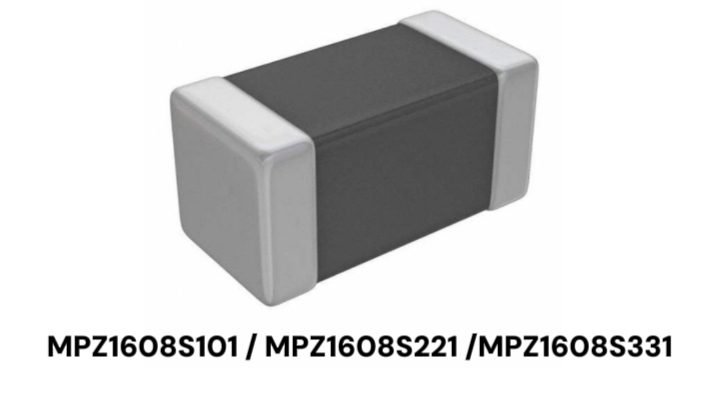
The MPZ1608S101ATAH0, MPZ1608S221ATA00, and MPZ1608S331ATA00 all belong to TDK’s MPZ1608S series of chip beads for power line noise suppression, in a 1608 metric / 0603 imperial package. The three parts share the same application focus. The real selection question is the trade-off among noise suppression capability, current handling, and DC loss.
Quick Decision
- MPZ1608S101ATAH0 (100Ω)— high-current power lines where low DCR and low voltage drop are priorities
- MPZ1608S221ATA00 (220Ω)— general-purpose power lines balancing suppression and current capability
- MPZ1608S331ATA00 (330Ω)— power branches with more noticeable high-frequency noise and relatively lower load current
Shared Platform
The three parts share the same physical and process platform:
| Item | Value |
| Package size | 1.6 mm × 0.8 mm × T (1608 metric / 0603 imperial) |
| Mounting | Surface mount (SMD) |
| Structure | Single-line chip bead |
| Impedance test frequency | 100 MHz |
| Impedance tolerance | ±25% |
| Application focus | Board-level power line high-frequency noise suppression |
The real selection differences are in the electrical and mechanical parameters below.
Side-by-Side Comparison
| Parameter | MPZ1608S101ATAH0 | MPZ1608S221ATA00 | MPZ1608S331ATA00 |
| Impedance @100 MHz | 100 Ω | 220 Ω | 330 Ω |
| Rated current | 3.0 A | 2.2 A | 1.7 A |
| DCR Max. | 30 mΩ | 50 mΩ | 80 mΩ |
| Thickness T | 0.60 mm | 0.80 mm | 0.80 mm |
| Positioning | High-current, low-loss | Balanced | High-impedance, strong suppression |
| Main trade-off | Lower suppression | Balanced current and suppression | Lowest current margin, highest DCR |
When to Pick Each
- MPZ1608S101ATAH0
Choose it when load current is higher and the design prioritizes voltage drop and heat. It is the highest-current and lowest-loss option of the three — even at full 3.0 A load, the worst-case DCR drop is only about 90 mV.
Typical fits:
- Low-voltage digital power rails
- MCU, SoC, FPGA peripheral supply branches
- Local power filtering after a DC/DC output
- Module power inputs sensitive to voltage drop
- Power lines with moderate noise but higher current
If the main issue is strong high-frequency noise rather than load current, evaluate the 220 Ω or 330 Ω options.
- MPZ1608S221ATA00
The balanced choice in this comparison. It strikes a reasonable balance among suppression, current handling, and DC loss, with about 110 mV drop at full 2.2 A load.
Typical fits:
- General power line EMI suppression
- Module power input filtering
- Sensor, interface IC, and communication module supply branches
- Power paths that need stronger suppression but not extreme current
- A safe middle ground between 100 Ω and 330 Ω
Early in design, when noise severity is not yet clear, 220 Ω is often a safer starting point.
- MPZ1608S331ATA00
Choose it when the power branch carries more noticeable high-frequency noise and load current is relatively lower. The 330 Ω impedance gives stronger suppression, but the 1.7 A rated current and 80 mΩ DCR limit its use — at full 1.7 A load the drop is about 136 mV.
Typical fits:
- Sensitive analog or mixed-signal supply branches
- Low-current communication modules
- Local IC power isolation in noisy environments
- Power branches more sensitive to high-frequency interference
- Fine filtering positions, not main high-current rails
If actual operating current is close to the rated value, or the supply voltage is low and the drop budget is tight, reconsider 220 Ω or 100 Ω.
Critical Trade-Offs
- Higher impedance demands more current margin
Going from 100 Ω to 330 Ω drops the rated current from 3.0 A to 1.7 A. The rated current is usually defined by steady-state temperature rise. Real selection should also account for inrush currents, transient loads, and ambient temperature, with adequate margin on top.
- DCR directly affects voltage drop and power loss
A bead in the power path produces a non-trivial DC drop:
- MPZ1608S101ATAH0 @ 3.0 A: ~90 mV drop, ~270 mW loss
- MPZ1608S221ATA00 @ 2.2 A: ~110 mV drop, ~242 mW loss
- MPZ1608S331ATA00 @ 1.7 A: ~136 mV drop, ~231 mW loss
On a 1.0 V or 1.2 V digital rail, hundred-millivolt drops eat a significant share of the supply budget, and low DCR often matters more than higher impedance.
- 100 MHz impedance is only a starting point
The nameplate impedance is measured at 100 MHz, but real EMI problems can sit anywhere from tens of MHz to GHz. Bead impedance follows an inductive–resistive–capacitive curve over frequency, and actual suppression must be read from the full Z-F curve. If the interference sits around 30 MHz, the 100 MHz numbers do not translate directly.
- DC bias reduces actual impedance
This is often overlooked. When DC current through the bead approaches the rated value, the ferrite material moves toward saturation, and actual impedance falls noticeably below the 100 MHz nominal — the exact reduction varies by part, operating current, and frequency. The standard MPZ1608 datasheet provides Z-vs-frequency and current-derating curves rather than DC bias curves, so the actual operating-point impedance is best assessed through TDK’s equivalent-circuit models (SPICE / S-parameter) or prototype measurement. For power lines that always run at high load current, choosing a higher-impedance, higher-margin part (for example, 220 Ω instead of 100 Ω, when current allows) can sometimes give better suppression at the actual operating point.
- Height envelope can drive the decision
MPZ1608S101ATAH0 is 0.60 mm thick; the other two are 0.80 mm. For wearables, compact modules, or double-sided PCBs sensitive to component height, the thickness gap should factor into the choice.
Outside These Three Parts
If system needs fall outside 100 Ω, 220 Ω, and 330 Ω, look further within MPZ1608 or adjacent series:
- Higher current, lower DCR: Among these three, MPZ1608S101ATAH0 already offers the highest current capability and lowest DCR. For even higher current or lower DC loss, evaluate the larger MPZ2012 package (2012 metric / 0805 imperial), or lower-impedance, lower-DCR parts within the same series
- Stronger high-frequency suppression: Move up the impedance ladder within MPZ1608, for example MPZ1608S471ATA00 (470 Ω), MPZ1608S601ATA00 (600 Ω), or MPZ1608S102ATA00 (1 kΩ), while re-checking rated current, DCR, and thermal margin
- Thinner build: Prioritize 0.60 mm low-profile versions for wearables, compact modules, or height-constrained double-sided PCBs
- Automotive or high-reliability requirements: If the application involves automotive electronics or explicitly requires AEC-Q200, select the corresponding part from TDK’s automotive MPZ1608 line — specifically, MPZ1608S101ATAH0 → MPZ1608S101ATDH5, MPZ1608S221ATA00 → MPZ1608S221ATD25, MPZ1608S331ATA00 → MPZ1608S331ATD25 (all AEC-Q200 qualified with the same electrical parameters as their commercial counterparts), rather than reusing the three commercial-grade parts compared here
- Target band away from 100 MHz: Read the full impedance-vs-frequency curve and, if needed, evaluate alternative material grades or beads tuned for the target band
Product Summary
| Part Number | Manufacturer | Key Advantage | Buy Now |
| MPZ1608S101ATAH0 | TDK | 100 Ω, 3.0 A, 30 mΩ — high-current, low-loss power lines | Buy Now |
| MPZ1608S221ATA00 | TDK | 220 Ω, 2.2 A, 50 mΩ — balanced general-purpose filtering | Buy Now |
| MPZ1608S331ATA00 | TDK | 330 Ω, 1.7 A, 80 mΩ — low-current high-frequency suppression | Buy Now |
WIN SOURCE offers TDK MPZ1608S series chip beads for consumer electronics, communication modules, IT equipment, industrial equipment, and board-level power noise suppression designs. Check current inventory and availability for MPZ1608S101ATAH0, MPZ1608S221ATA00, and MPZ1608S331ATA00 at WIN SOURCE.
©2026 Win Source Electronics. All rights reserved. This content is protected by copyright and may not be reproduced, distributed, transmitted, cached or otherwise used, except with the prior written permission of Win Source Electronics.