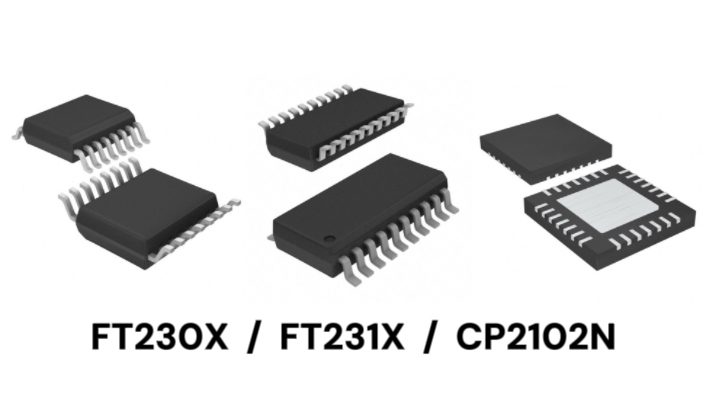
USB-to-UART selection involves more than baud rate. Handshaking signals, I/O voltage, package, driver support, configuration, and RS-485 direction control all affect PCB layout, software integration, and maintenance.
FTDI’s FT230XS-R and FT231XS-R and Silicon Labs’ CP2102N-A02-GQFN28R integrate a USB 2.0 full-speed controller, USB transceiver, and on-chip clock generation, so no external crystal is required. All support 300 baud to 3 Mbaud and handle the USB protocol on-chip. Key differences are control signals, I/O architecture, auxiliary functions, package, and software tools.
Using the lower-pin-count FT230XS-R as the baseline, this guide highlights practical selection criteria for new designs, upgrades, and cross-vendor replacements.
Key Specification Comparison
| Parameter | FT230XS-R | FT231XS-R | CP2102N-A02-GQFN28R |
| Product positioning | Basic USB-to-UART bridge | Full-handshake USB-to-UART bridge | Feature-rich USB-to-UART bridge |
| UART data and control signals | TXD, RXD, RTS#, CTS# | TXD, RXD, RTS#, CTS#, DTR#, DSR#, DCD#, RI# | TXD, RXD, RTS, CTS, DTR, DSR, DCD, RI |
| Main supply range | VCC: 2.97-5.5 V | VCC: 2.97-5.5 V | VDD: 3.0-3.6 V; or VREGIN: 3.0-5.25 V |
| UART I/O voltage domain | VCCIO: 1.62-3.63 V; 5 V-tolerant inputs | VCCIO: 1.62-3.63 V; 5 V-tolerant inputs | No separate VIO on QFN28; I/O follows VDD (3.0-3.6 V) |
| Configuration memory | 2,048-byte MTP | 2,048-byte MTP | 960-byte programmable ROM |
| Typical operating current | 8 mA | 8 mA | 9.5 mA at 115.2 kbaud; 13.7 mA at 3 Mbaud |
| Configurable I/O | Four multifunction CBUS pins | Four multifunction CBUS pins | Up to seven GPIOs with multiplexed functions |
| Package | 16-pin SSOP | 20-pin SSOP | 28-pin QFN, 5 x 5 mm |
| Drivers and tools | VCP / D2XX; FT_PROG | VCP / D2XX; FT_PROG | VCP / USBXpress; Xpress Configurator |
Application Fit
- FT230XS-R
Best suited for: Compact MCU debug ports, sensor interfaces, data loggers, and serial adapters requiring basic USB-to-UART connectivity and an SSOP package.
Design insight: The FT230XS-R provides TXD, RXD, RTS#, and CTS#. Its 16-pin package simplifies routing and connector design. It is the most direct choice when DTR, DSR, DCD, and RI are not needed, but future modem-control requirements should be considered.
- FT231XS-R
Best suited for: Industrial instruments, external RS-232 transceiver interfaces, and serial converters requiring full handshaking while retaining FTDI VCP/D2XX drivers and FT_PROG.
Design insight: The FT231XS-R shares the FT-X platform and driver ecosystem of the FT230XS-R, while adding DTR#, DSR#, DCD#, and RI#. It expands UART control without changing software platforms, but its SSOP-20 package requires more routing.
- CP2102N-A02-GQFN28R
Best suited for: New 3.3 V I/O designs requiring full handshaking, additional GPIOs, remote wakeup, or configurable RS-485 direction control.
Design insight: The QFN-28 device offers up to seven GPIOs, some of which can be configured for TX/RX activity indication, RS-485 direction control, and WAKEUP. The clock-output function is multiplexed with the RI pin. It suits Silicon Labs VCP/USBXpress platforms, but is not a drop-in FTDI replacement because its power architecture, package, pinout, USB configuration, and drivers differ.
Design Considerations
- Handshaking and System Resources
Use the FT230XS-R when TX/RX and RTS/CTS are sufficient. Designs requiring DTR, DSR, DCD, or RI should consider the FT231XS-R or CP2102N-A02-GQFN28R.
Additional control signals improve compatibility with some equipment and software, but consume more connector contacts and PCB routing.
All three support up to 3 Mbaud. Actual throughput and latency also depend on USB host scheduling, drivers, packet size, buffering, and the operating system, so performance-sensitive designs should be tested in the target system.
- Power and Logic Levels
The FT230XS-R and FT231XS-R use a 2.97-5.5 V main supply and provide VCCIO for 1.8 V, 2.5 V, or 3.3 V logic. Their UART and CBUS inputs are 5 V tolerant, but output levels follow VCCIO; this is not full bidirectional 5 V compatibility.
The CP2102N-A02-GQFN28R has no separate VIO pin, so digital I/O follows VDD at 3.0-3.6 V. Applying 5 V to VREGIN does not create 5 V I/O. Check input thresholds and absolute-maximum ratings before deciding whether level shifting is required.
- Drivers, Configuration, and Production Programming
The FT230XS-R and FT231XS-R use FTDI VCP/D2XX drivers and FT_PROG for USB descriptors, serial numbers, and CBUS functions. Migration within the FT-X family is relatively simple, but pin functions, defaults, and production files still require review.
The CP2102N-A02-GQFN28R uses Silicon Labs VCP/USBXpress drivers, and Xpress Configurator programs its internal ROM. Cross-vendor migration should verify driver deployment, COM-port enumeration, VID/PID and serial-number settings, suspend and wakeup behavior, and production programming.
Product Summary
| Product | Manufacturer | Selection Focus | Buy |
| FT230XS-R | FTDI | Basic UART with TX/RX and RTS/CTS | Buy Now |
| FT231XS-R | FTDI | Full handshaking within the FTDI ecosystem | Buy Now |
| CP2102N-A02-GQFN28R | Silicon Labs | 3.3 V design with GPIO and auxiliary functions | Buy Now |
WIN SOURCE supplies FTDI and Silicon Labs USB interface devices, including these three models. Before approving a substitute, confirm inventory and lead time, then validate package, pinout, I/O voltage, drivers, and production configuration. Visit WIN SOURCE to check availability and request a quote.
©2026 Win Source Electronics. All rights reserved. This content is protected by copyright and may not be reproduced, distributed, transmitted, cached or otherwise used, except with the prior written permission of Win Source Electronics.