
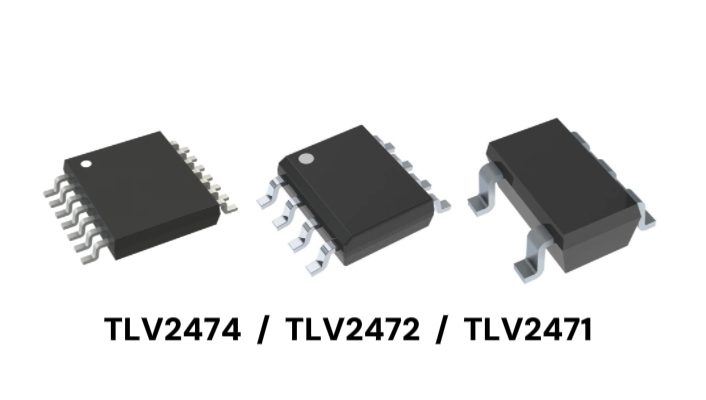
In automotive electronics and low-voltage analog front-end design, op amp selection should not be based on a single parameter alone. The first step is to decide whether the system needs higher channel integration or more flexible placement close to the signal source.
TLV2474QPWPRQ1, TLV2472QDRQ1, and TLV2471QDBVRQ1 are all part of TI’s automotive-grade TLV247x-Q1 family. They share the same core electrical platform, with the main differences being channel count and package type. In practice, choosing between them is usually less about electrical performance and more about which configuration best fits the actual circuit architecture.
Parameter Comparison
- Shared Core Specifications
| Parameter | TLV247x-Q1 Family |
| Supply Voltage Range | 2.7 V to 6 V |
| Gain-Bandwidth Product | 2.8 MHz |
| Slew Rate | 1.5 V/µs |
| Typical Quiescent Current | 600 µA per channel |
| Typical Input Offset Voltage | 250 µV typ |
| Operating Temperature Range | -40°C to 125°C |
| Key Features | RRIO, automotive-grade, strong output drive capability |
- Key Differences
| Model | Channels | Package | Best Fit |
| TLV2474QPWPRQ1 | 4 | HTSSOP-14 | Centralized multi-channel designs |
| TLV2472QDRQ1 | 2 | SOIC-8 | Dual-channel signal chains |
| TLV2471QDBVRQ1 | 1 | SOT-23-5 | Single-channel, distributed layouts |
Application Analysis
- TLV2474QPWPRQ1
TLV2474QPWPRQ1 is a good fit for designs that handle multiple analog signals within the same module, such as buffering, amplification, or filtering. Its main advantage is not better single-channel performance, but higher integration. A quad op amp can reduce component count, simplify layout, and support a more standardized analog front-end design.
If the board already requires three or four op amp channels, the quad version is usually the most practical choice. If fewer channels are needed, or the signal nodes are spread across the board, it may not be the best fit.
- Typical applications:
Multi-channel sensor signal conditioning
Automotive data acquisition front ends
Centralized buffering and filtering stages
Standardized automotive analog front-end platforms
- TLV2472QDRQ1
TLV2472QDRQ1 is well suited for two-channel analog signal chains. It uses the same family platform as TLV2474QPWPRQ1, but its channel count is better aligned with dual-channel designs and avoids unnecessary channel overhead.
For applications that only need two op amps, the dual version often offers a better balance of board space, cost, and design simplicity.
- Typical applications:
Dual-channel analog signal conditioning
Two-stage signal chains (e.g., amplification followed by buffering)
Paired sensor input processing
Designs that avoid unused channels
- TLV2471QDBVRQ1
TLV2471QDBVRQ1 is better suited for single-channel and distributed analog nodes. A single op amp is easier to place close to the sensor, ADC, or local reference point, which helps shorten the signal path and improve layout flexibility.
If the analog functions in the system are distributed across different areas of the board, the single-channel version is often a more practical choice than using a quad device in a centralized layout.
- Typical applications:
Single-channel sensor front ends
ADC input buffering
Local reference voltage buffering
Distributed analog node layouts
Design Considerations
- Start with channel allocation, then review the specs
Across the TLV247x-Q1 family, the three devices use essentially the same core electrical platform. That means the first step is not to compare specifications, but to determine how many op amp channels the design actually needs and whether those channels should be placed centrally or distributed across the board.
Without that decision, comparing bandwidth, offset voltage, or quiescent current is of limited value.
- Best suited for general low-voltage signal conditioning
With a 2.8 MHz gain-bandwidth product and a 1.5 V/µs slew rate, the TLV247x-Q1 family is better suited for sensor interfaces, low-voltage data acquisition, general-purpose buffering, and medium-frequency active filtering. It is not intended for high-speed or fast transient-response applications. TI also positions this family for applications such as sensor interfaces, portable medical equipment, and data acquisition circuits.
- RRIO does not guarantee full rail swing under all load conditions
Rail-to-rail input and output operation is useful in 3.3 V and 5 V systems, but in practice, designers should not rely on the RRIO label alone. According to TI data, under a 10 mA load, the output can typically swing to within about 180 mV of the supply rails. When full rail swing is not required, the device can deliver ±35 mA of output current at 500 mV from the rails.
For signal chains operating close to the supply rails, output load, voltage headroom, and the input range of the next stage still need to be checked carefully.
- 600 µA per channel indicates efficiency, not weak drive capability
The 600 µA per channel figure highlights the low-power nature of the TLV247x-Q1 family, but this is not a weak-drive micropower op amp in the traditional sense. TI positions this family as offering relatively strong output drive while maintaining low quiescent current, addressing the limited drive capability often seen in older micropower amplifiers.
A more accurate description would be a low-power, general-purpose RRIO op amp with relatively strong output drive capability. If the application requires higher speed, sustained high output current, or heavier load driving, a device with higher bandwidth or higher output current capability may be a better choice.
- Automotive qualification makes platform reuse easier
This family is AEC-Q100 qualified and specified over a temperature range of -40°C to 125°C. It is also characterized across the automotive temperature range under both 3 V and 5 V operating conditions, making it well suited for platform-based designs across different ECUs or modules.
For platform-based projects, that consistency is often more valuable than small differences in a single parameter.
Product Summary
| Model | Positioning | Key Takeaway | Purchase |
| TLV2474QPWPRQ1 | Quad-channel centralized solution | Best for multi-channel signal conditioning where integration and platform consistency matter | Buy Now |
| TLV2472QDRQ1 | Balanced dual-channel solution | Best for dual-channel signal paths while avoiding unused channels | Buy Now |
| TLV2471QDBVRQ1 | Flexible single-channel solution | Best for local placement and distributed analog nodes | Buy Now |
WIN SOURCE offers sourcing support for a wide range of TI automotive op amps, including popular devices such as TLV2474QPWPRQ1, TLV2472QDRQ1, and TLV2471QDBVRQ1. By considering channel count, package type, layout strategy, and system requirements for low-voltage operation, rail-to-rail input/output, and output drive capability, engineers can complete device selection more efficiently. Visit WIN SOURCE to check real-time inventory and lead times, helping to shorten procurement cycles and keep projects moving forward.
©2026 Win Source Electronics. All rights reserved. This content is protected by copyright and may not be reproduced, distributed, transmitted, cached or otherwise used, except with the prior written permission of Win Source Electronics.

COMMENTS