* Question
What Is a Flexible Manufacturing System?
* Answer
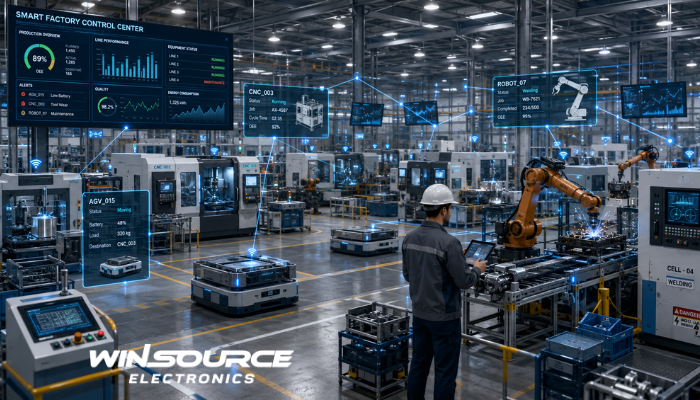
A Flexible Manufacturing System (FMS) is an automated production system that can quickly adapt to changes in product types, production volumes, and manufacturing requirements. It combines computer-controlled machines, automated material handling equipment, and centralized control software to achieve efficient and flexible production.
Unlike traditional dedicated production lines designed for a single product, an FMS can manufacture different products or components with minimal manual adjustment. It is widely used in industries that require high product variety, shorter production cycles, and rapid market response.
What Are the Main Components of a Flexible Manufacturing System?
A typical FMS consists of several key elements:
1. Computer Numerical Control (CNC) Machines
CNC machines are the core processing units of an FMS.
They perform manufacturing operations such as:
- Cutting
- Milling
- Drilling
- Turning
- Precision machining
Because CNC machines are programmable, they can switch between different production tasks by changing software instructions rather than replacing equipment.
2. Automated Material Handling System
The material handling system transfers workpieces, tools, and materials between different processing stations.
Common equipment includes:
- Automated guided vehicles (AGVs)
- Conveyor systems
- Robotic arms
- Storage and retrieval systems
This reduces manual handling and improves production efficiency.
3. Industrial Robots
Robots provide flexibility in tasks that require repeatability and precision.
Typical applications include:
- Assembly
- Welding
- Inspection
- Packaging
- Material loading and unloading
Robots allow manufacturers to adjust production processes quickly when product designs change.
4. Computer Control System
The control system manages the operation of the entire FMS.
It coordinates:
- Machine scheduling
- Production monitoring
- Equipment communication
- Process optimization
- Data collection
Modern FMS platforms are often integrated with:
- Manufacturing Execution Systems (MES)
- Enterprise Resource Planning (ERP)
- Industrial IoT platforms
5. Automated Inspection Equipment
Quality control is an important part of flexible manufacturing.
Inspection systems use technologies such as:
- Machine vision
- Sensors
- Measurement equipment
They help detect defects during production and maintain consistent product quality.
How Does a Flexible Manufacturing System Work?
The basic workflow of an FMS includes:
- Production orders are received by the control system.
- The system determines the required manufacturing process and resources.
- Materials are automatically transported to the appropriate machines.
- CNC machines and robots perform manufacturing operations.
- Inspection systems verify product quality.
- Finished products are transferred for storage or the next production stage.
Because the system is controlled by software, manufacturers can modify production schedules and product configurations with greater efficiency.
What Are the Main Advantages of FMS?
1. High Production Flexibility
FMS allows manufacturers to produce multiple product models using the same equipment.
This is especially valuable for industries with:
- Frequent product changes
- Customized production requirements
- Small and medium batch manufacturing
2. Improved Production Efficiency
Automation reduces idle time and improves equipment utilization.
Benefits include:
- Faster production cycles
- Reduced manual operations
- Better resource allocation
3. Better Product Quality
Automated processes provide higher consistency compared with manual production.
Integrated inspection systems help maintain stable quality standards.
4. Reduced Labor Requirements
FMS reduces repetitive manual tasks and allows operators to focus on:
- System management
- Process optimization
- Maintenance activities
5. Faster Response to Market Changes
Manufacturers can quickly adjust production plans when customer demand changes, making FMS an important technology for modern smart manufacturing.
Where Are Flexible Manufacturing Systems Used?
FMS technology is widely applied in industries such as:
Automotive Manufacturing
Used for:
- Engine components
- Transmission parts
- Precision machining
Aerospace Manufacturing
Supports:
- Complex component production
- High-precision machining
- Small-batch manufacturing
Electronics Manufacturing
Used in:
- Automated assembly
- PCB production
- Component handling
Medical Device Manufacturing
Supports the production of:
- Precision medical instruments
- Customized components
Industrial Equipment Manufacturing
Helps produce machinery parts with different specifications while maintaining efficiency.
What Is the Role of Electronic Components in Flexible Manufacturing Systems?
Modern FMS relies heavily on electronic components to achieve automation and intelligent control.
Important components include:
- Microcontrollers (MCUs)for embedded control
- Industrial processorsfor system management
- Sensorsfor position, temperature, and pressure monitoring
- Power componentsfor motor drives and automation equipment
- Communication ICsfor industrial networks
- Memory devicesfor data storage and system operation
The reliability and availability of these components directly affect manufacturing stability and equipment uptime.
What Is the Future Trend of Flexible Manufacturing Systems?
With the development of Industry 4.0, artificial intelligence, and industrial IoT, FMS is evolving toward more intelligent manufacturing systems.
Future trends include:
- AI-based production optimization
- Real-time equipment monitoring
- Predictive maintenance
- Digital twin integration
- Autonomous manufacturing operations
Flexible Manufacturing Systems will continue to play an important role in helping manufacturers achieve more efficient, adaptive, and intelligent production.