* Question
What Are the Advantages of RFID Technology?
* Answer
RFID (Radio Frequency Identification) is a wireless identification technology that uses radio waves to automatically identify and track objects, people, or assets through RFID tags and readers.
Compared with barcodes or manual tracking systems, RFID offers significant improvements in efficiency, accuracy, and automation.
Key Advantages of RFID
1. No Line-of-Sight Required
Unlike barcodes, RFID does not need visual contact.
- Tags can be read through packaging, plastic, cardboard, or non-metal materials
- Enables faster scanning in real-world environments
This is a major advantage in logistics and warehouse operations.
2. Faster Data Capture
RFID systems can read multiple tags simultaneously.
- Dozens or even hundreds of tags can be scanned in seconds
- Greatly reduces manual scanning time
This makes RFID ideal for:
- Inventory counting
- Pallet tracking
- Large-scale asset management
3. Long Read Range (Depending on Frequency)
RFID can operate over different distances:
- LF: a few centimeters
- HF: up to ~1 meter
- UHF: several meters or more
UHF RFID enables bulk, long-distance scanning in warehouses and supply chains.
4. High Data Storage Capacity
RFID tags can store more information than barcodes.
- Product ID
- Serial number
- Manufacturing data
- Maintenance history
- Location or status information
This enables dynamic and traceable data systems.
5. Improved Accuracy and Reduced Human Error
RFID minimizes manual operations:
- No need for line-by-line scanning
- Automated data collection
- Reduced misreading or missed scans
This significantly improves supply chain data integrity.
6. Real-Time Tracking Capability
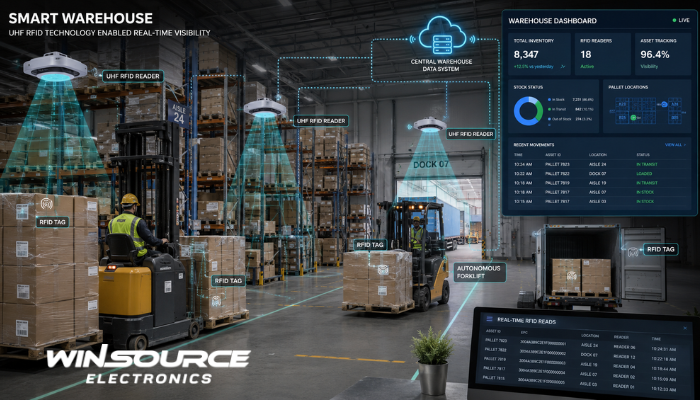
RFID systems can provide near real-time visibility.
- Track movement of goods across warehouses
- Monitor asset location in large facilities
- Support intelligent inventory systems
This is especially important for smart logistics and Industry 4.0.
7. Durability and Reusability
RFID tags are generally:
- Resistant to dust, dirt, and moisture
- More durable than printed barcodes
- Some tags are reusable (especially active RFID tags)
8. Security and Authentication Benefits
RFID can include encryption and authentication features.
- Prevents counterfeiting
- Used in access control systems
- Supports secure identity verification (e.g., ID cards, passports)
9. Automation and Labor Cost Reduction
RFID reduces the need for manual scanning and tracking:
- Faster warehouse operations
- Lower labor requirements
- Higher operational efficiency
10. Scalability for Large Systems
RFID systems scale easily:
- Can handle thousands to millions of tagged items
- Suitable for global supply chain systems
- Easily integrated into ERP and IoT platforms
Summary Table
Advantage | Benefit |
No line-of-sight required | Easier and faster scanning |
Multi-tag reading | Bulk identification |
Long read range | Flexible industrial use |
High data capacity | Rich information storage |
High accuracy | Reduced human error |
Real-time tracking | Better visibility |
Durable tags | Long service life |
Security features | Anti-counterfeiting |
Automation | Lower labor cost |
Scalability | Enterprise-level deployment |
Conclusion
RFID provides a major upgrade over traditional identification systems by enabling fast, contactless, multi-object tracking with high accuracy and automation capabilities. It is widely used in logistics, retail, manufacturing, and access control systems, forming a core technology in modern intelligent supply chains.