* Question
What Are the Functions of the MAC Sublayer?
* Answer
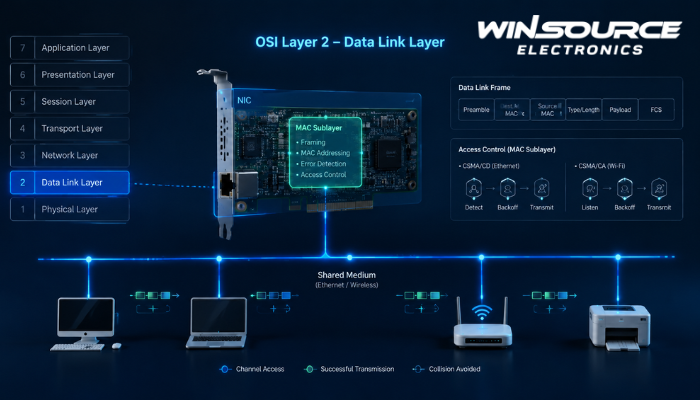
The MAC (Media Access Control) sublayer is a key part of the Data Link Layer (Layer 2) in the OSI model. It is responsible for controlling how devices in a shared network environment access the transmission medium and how data frames are transmitted and received.
In simple terms, the MAC sublayer ensures that multiple devices can share the same communication channel efficiently and without collision (or with controlled collision handling).
Core Functions Implemented by the MAC Sublayer
1. Frame Encapsulation and Delimitation
The MAC sublayer takes data from the LLC (Logical Link Control) layer and:
- Encapsulates it into MAC frames
- Adds a MAC header and trailer
- Defines frame boundaries (start and end of frame)
A typical MAC frame includes:
- Destination MAC address
- Source MAC address
- Control information
- Frame Check Sequence (FCS) for error detection
2. MAC Addressing
Each network interface has a unique MAC address (48-bit in Ethernet).
The MAC sublayer:
- Adds source MAC address to outgoing frames
- Reads destination MAC address of incoming frames
- Determines whether a frame is intended for the local device
This enables device-level identification on a LAN.
3. Media Access Control (Channel Access Management)
This is the most important function.
The MAC sublayer controls how devices access the shared transmission medium.
Depending on the network type, it may use:
- CSMA/CD (Ethernet, collision detection in legacy systems)
- CSMA/CA (Wi-Fi, collision avoidance)
- Token passing (industrial or legacy networks)
It ensures:
- Fair access to the medium
- Reduced or avoided collisions
- Efficient use of bandwidth
4. Frame Transmission and Reception
The MAC sublayer manages:
- Sending frames onto the physical medium
- Receiving frames from the physical layer
- Passing valid frames upward to the LLC sublayer
It also handles timing and synchronization for reliable frame delivery.
5. Error Detection (Frame Check Sequence)
The MAC sublayer includes error detection using:
- Cyclic Redundancy Check (CRC)
- Stored in the Frame Check Sequence (FCS) field
At reception:
- Receiver recalculates CRC
- If mismatch → frame is discarded
It does not correct errors, only detects them.
6. Collision Handling (in Shared Media Systems)
In shared networks (like classic Ethernet or Wi-Fi), MAC handles:
- Collision detection (CSMA/CD in older Ethernet)
- Collision avoidance (CSMA/CA in wireless systems)
- Backoff algorithms and retransmission strategies
7. Frame Filtering and Address Recognition
The MAC sublayer filters incoming frames:
- Accepts frames addressed to itself
- Accepts broadcast frames
- May accept multicast frames if configured
- Drops irrelevant frames early to reduce CPU load
8. Flow Control (in some implementations)
In certain MAC protocols (e.g., Ethernet PAUSE frames):
- Prevents buffer overflow
- Temporarily pauses transmission from sender
- Helps maintain stable throughput under congestion
Summary Table
Function | Description |
Frame encapsulation | Builds MAC frames with headers/trailers |
MAC addressing | Uses unique hardware addresses |
Media access control | Manages who transmits and when |
Transmission/reception | Handles frame delivery over PHY |
Error detection | Uses CRC/FCS to detect corrupted frames |
Collision handling | Manages retransmission in shared media |
Frame filtering | Accepts or discards frames based on MAC |
Flow control | Prevents congestion (in some systems) |
Conclusion
The MAC sublayer is responsible for controlling access to the physical medium and ensuring reliable frame-based communication between devices on a local network. It acts as the bridge between raw signal transmission (Physical Layer) and logical data handling (LLC), making orderly and efficient communication possible in shared networks.