
* Question
What Are the Units of Commonly Used Resistors?
* Answer
The value of a resistor indicates how much it resists the flow of electric current.
This resistance is measured using standard units defined by the International System of Units (SI).
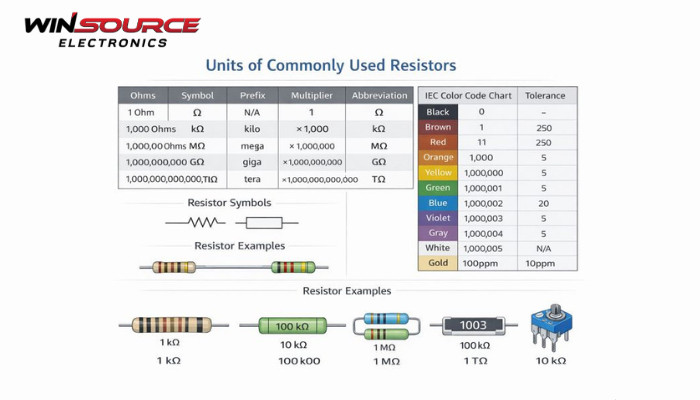
The commonly used units for resistors are based on the ohm (Ω).
1. Ohm (Ω)
The ohm (Ω) is the basic unit of resistance.
- 1 Ω means the resistance that allows 1 ampere of current to flow when 1 volt is applied
- Used for low-resistance components
Typical examples:
- 10 Ω
- 220 Ω
- 1 kΩ (1000 Ω)
2. Kilohm (kΩ)
The kilohm (kΩ) is equal to 1,000 ohms.
1 kΩ=1,000Ω
Typical applications:
- Signal circuits
- Pull-up or pull-down resistors
- Bias networks
Common values:
- 7 kΩ
- 10 kΩ
- 47 kΩ
3. Megohm (MΩ)
The megohm (MΩ) is equal to 1,000,000 ohms.
1 MΩ=1,000,000Ω
Typical applications:
- High-impedance circuits
- Voltage measurement and sensing
- Leakage current limiting
Common values:
- 1 MΩ
- 10 MΩ
4. Sub-Ohm Units (Milliohm, mΩ)
For very low resistance values, milliohms (mΩ) are used.
1 mΩ=0.001Ω
Typical applications:
- Current sensing resistors
- Power management circuits
These resistors are designed for high-current measurement.
Engineering Insight
Resistor values are often printed using:
- Color codes
- Numeric markings
- EIA codes (for SMD resistors)
Understanding resistance units helps customers:
- Read resistor values correctly
- Select proper components
- Avoid wiring and design errors
Conclusion
The commonly used units for resistors are:
- Ohm (Ω)– basic unit
- Kilohm (kΩ)– thousands of ohms
- Megohm (MΩ)– millions of ohms
- Milliohm (mΩ)– very low resistance values
These units cover the full range of resistor applications, from high-current sensing to high-impedance signal control.

COMMENTS