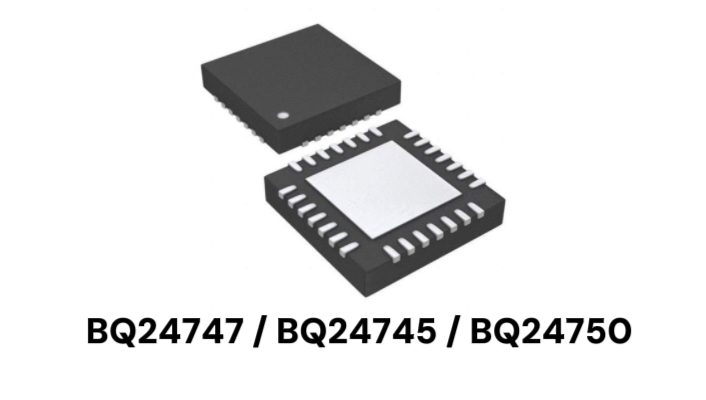
BQ24747RHDR, BQ24745RHDR, and BQ24750RHDR are TI battery charge controllers designed for 2–4 cell Li+ battery packs. They are commonly used in notebooks, portable industrial terminals, medical devices, and battery backup systems.
Although the three devices share the same 28-pin 5 × 5 mm QFN/VQFN package, they should not be treated as drop-in replacements. The real selection factors are control interface, voltage range, protection functions, external power-stage requirements, and lifecycle status..
Parameter Comparison
| Parameter | BQ24747RHDR | BQ24745RHDR | BQ24750RHDR |
| Charge voltage range | 1.024–19.2 V | 1.024–19.2 V | 4–4.512 V/cell, up to 18.048 V for 4S |
| Charge current limit | 8.064 A | 8.064 A | 10 A with 10 mΩ sense resistor |
| Adapter input | 7–24 V | 7–24 V | 5–24 V |
| Control interface | SMBus | SMBus | Resistor / DAC / GPIO ratiometric analog control |
| Input OVP | No* | No | Yes |
| ACOP / ACOC | No | No | Yes |
| Reverse conduction protection | No | No | Yes |
| TS battery temperature sense | No | No | Yes |
| System power selection | External logic required | External logic required | Integrated system power selector |
| Internal loop compensation | No | No | Yes |
| Lifecycle | Distributor-listed obsolete | NRND, supplied to existing customers | Active; BQ24750A may also be evaluated |
* The BQ24747 datasheet feature list mentions input OVP, but the body text and electrical characteristics do not provide a corresponding threshold or timing specification. TI has clarified on its E2E forum that this is a datasheet typo. For practical selection purposes, input OVP should not be counted as an available function.
Recommended Use Cases
- BQ24747RHDR
BQ24747RHDR is mainly suitable for existing BQ24747-based platforms. It is best used for repair, rework, and lifecycle extension of legacy designs where major PCB, BOM, or EC firmware changes are not preferred.
It is also suitable when the design must retain the 19.2 V charge voltage ceiling. Compared with BQ24745RHDR, the key differences are mainly related to abnormal-condition behavior. BQ24747RHDR uses a single PGND instead of a separate analog ground and changes the charge inhibit and soft-start behavior under low BAT conditions.
According to the Battery Shorted / Undervoltage Protection section, charge current is limited to 128 mA when VFB falls below the short-circuit threshold. After recovery, the charge current returns to the register-set value.
- BQ24745RHDR
BQ24745RHDR is suitable for maintaining existing BQ24745 platforms or evaluating substitution with BQ24747RHDR. It is also useful for legacy systems that need to keep SMBus-based control and avoid EC firmware changes.
Before substitution, three points should be verified:
- Grounding design: BQ24745RHDR has a separate AGND, while BQ24747RHDR uses a single PGND.
- Low-battery recovery behavior: BQ24747RHDR changes the charge inhibit and soft-start behavior during low BAT conditions. If the EC firmware monitors recovery timing or charge-current ramp rate, bench validation is required.
- VICM filtering: Reference designs typically use a capacitance around 100 pF. If the legacy BOM uses a larger value, input current sensing bandwidth and DPM trigger response should be rechecked.
- BQ24750RHDR
BQ24750RHDR is more suitable for new designs or systems that can re-architect the power path. It is a strong option when the design requires input OVP, ACOP/ACOC, reverse conduction protection, TS battery temperature sensing, or wider adapter input support from 5 V.
Its main value is the combination of system-level protection and power-path management. It integrates input OVP, ACOP/ACOC, reverse conduction protection, a TS pin, a 6 V gate-drive system power selector, and internal loop compensation. This can reduce several external compensation components and simplify the overall design.
The main migration cost is the control method. BQ24747RHDR and BQ24745RHDR use SMBus register-based control, while BQ24750RHDR uses ratiometric analog control through resistors, DAC, or GPIO. If the original system relies on the EC to dynamically adjust charge parameters through SMBus, moving to BQ24750RHDR requires changes to both the hardware design and firmware strategy.
Key Selection Considerations
- 19.2 V vs 18.048 V
The BQ24750RHDR voltage ceiling is lower than that of BQ24747RHDR and BQ24745RHDR, but it still covers most mainstream 4S Li-ion pack configurations.
| Battery type | 4S full-charge voltage |
| Standard Li-ion, 4.20 V/cell | 16.8 V |
| High-voltage Li-ion, 4.35 V/cell | 17.4 V |
| Silicon-carbon high-voltage, 4.45 V/cell | 17.8 V |
| BQ24750RHDR / BQ24750A ceiling | 18.048 V |
| BQ24747RHDR / BQ24745RHDR ceiling | 19.2 V |
The 19.2 V ceiling is mainly needed for non-standard high-voltage cells above 4.5 V/cell, non-Li battery systems in longer series strings, or applications where active balancing may temporarily raise the pack voltage. For most Li-ion applications, the battery datasheet and protection-board thresholds should be checked before excluding BQ24750RHDR.
- SMBus Watchdog and Firmware Reliability
BQ24745RHDR and BQ24747RHDR depend on SMBus configuration. At power-up, ChargeVoltage and ChargeCurrent default to 0, keeping the charger disabled. InputCurrent defaults to 256 mA.
The watchdog timeout is typically 170 seconds, with a specified range of 140–210 seconds. Once the watchdog times out, charging stops. The host must resend ChargeVoltage or ChargeCurrent to restart charging. For reliable operation, the EC heartbeat should be set comfortably below the minimum timeout, such as 100 seconds or shorter.
Firmware should also handle adapter insertion before EC boot, EC reset, sleep or shutdown charging, low-battery recovery, brief SMBus communication failures, and adapter re-insertion. If these cases are not covered, the system may show symptoms such as no charging, low charge current, or delayed recovery after reset.
BQ24750RHDR does not have this SMBus dependency. Its power-up behavior is more hardware-determined, but it also does not provide the same flexibility for dynamic SMBus reconfiguration.
- 10 A Charging Requires System-Level Design
The 10 A rating of BQ24750RHDR should be treated as a system-level design target, not only a device-level specification. To reach 10 A reliably, the surrounding BOM and PCB layout must also support the current level.
Key design points include:
- Sense resistor: 10 mΩ at 10 A dissipates 1 W. A 2 W low-TCR metal-foil resistor is recommended.
- MOSFET: The 6 V gate drive requires logic-level MOSFETs. Devices with unsuitable gate-drive characteristics may cause excessive conduction loss.
- Inductor: For a 300 kHz, 4S 16.8 V system with around 30% ripple current, an inductance of about 6.8–10 μH and saturation current of at least 12 A should be considered.
- PCB layout: The QFN exposed pad requires a large copper area and sufficient thermal vias. Thermal performance becomes critical at high charge current.
- Adapter power: If the adapter cannot support both system load and charging current, DPM will reduce the actual charge current.
For 4–5 A applications, these requirements are easier to meet. The advantages of BQ24750RHDR become more significant when the target charge current is above 8 A.
Quick Selection Summary
| Scenario | Recommended Option |
| Repair of an existing BQ24747 platform | BQ24747RHDR |
| Repair of an existing BQ24745 platform | BQ24745RHDR |
| BQ24747RHDR and BQ24745RHDR cross-evaluation | Verify AGND/PGND, BAT recovery behavior, and SMBus timing |
| Legacy platform with no EC firmware change | Stay with BQ24745RHDR / BQ24747RHDR path |
| New design requiring OVP, TS, or ACOP/ACOC | BQ24750RHDR / BQ24750A |
| Charge current target above 8 A | BQ24750RHDR / BQ24750A |
| Charge voltage target above 18.048 V | BQ24747RHDR / BQ24745RHDR path |
| Long-lifecycle new production project | Evaluate newer TI charger architectures |
Newer TI Options to Consider
- For new projects with a production horizon of more than three years, it is better not to limit the evaluation to only these three devices. Newer TI charger families may provide better lifecycle support and system integration.
- BQ2477x family: SMBus/I²C NVDC charge controllers with input current, charge current, charge voltage, and minimum system voltage regulation. They also provide PROCHOT, PMON, and ACFET/RBFET drivers.
- BQ24780S: SMBus 1–4 cell buck charger with hybrid power boost, suitable for notebook platforms and processor power management.
- BQ24725A: SMBus 1–4 cell buck charger with integrated N-channel MOSFET selector in a compact 20-VQFN 3.5 × 3.5 mm package. It is suitable for mid-power portable applications.
Product Summary
| Part Number | Manufacturer | Key Strengths | Buy Now |
| BQ24747RHDR | Texas Instruments | SMBus control, 19.2 V voltage ceiling, 8.064 A current setting range | Buy Now |
| BQ24745RHDR | Texas Instruments | Close to BQ24747RHDR in platform requirements; suitable for legacy maintenance and substitution evaluation | Buy Now |
| BQ24750RHDR | Texas Instruments | 10 A charge capability, input OVP, ACOP/ACOC, reverse conduction protection, TS sensing, system power selector | Buy Now |
WIN SOURCE supplies a wide range of TI battery charger management ICs, covering multi-cell Li+, NVDC, SMBus/I²C, and analog-controlled architectures. These devices are suitable for notebooks, portable industrial terminals, medical equipment, battery backup systems, and processor power platforms. Visit WIN SOURCE to check real-time stock and availability for BQ24747RHDR, BQ24745RHDR, and BQ24750RHDR.
©2026 Win Source Electronics. All rights reserved. This content is protected by copyright and may not be reproduced, distributed, transmitted, cached or otherwise used, except with the prior written permission of Win Source Electronics.